
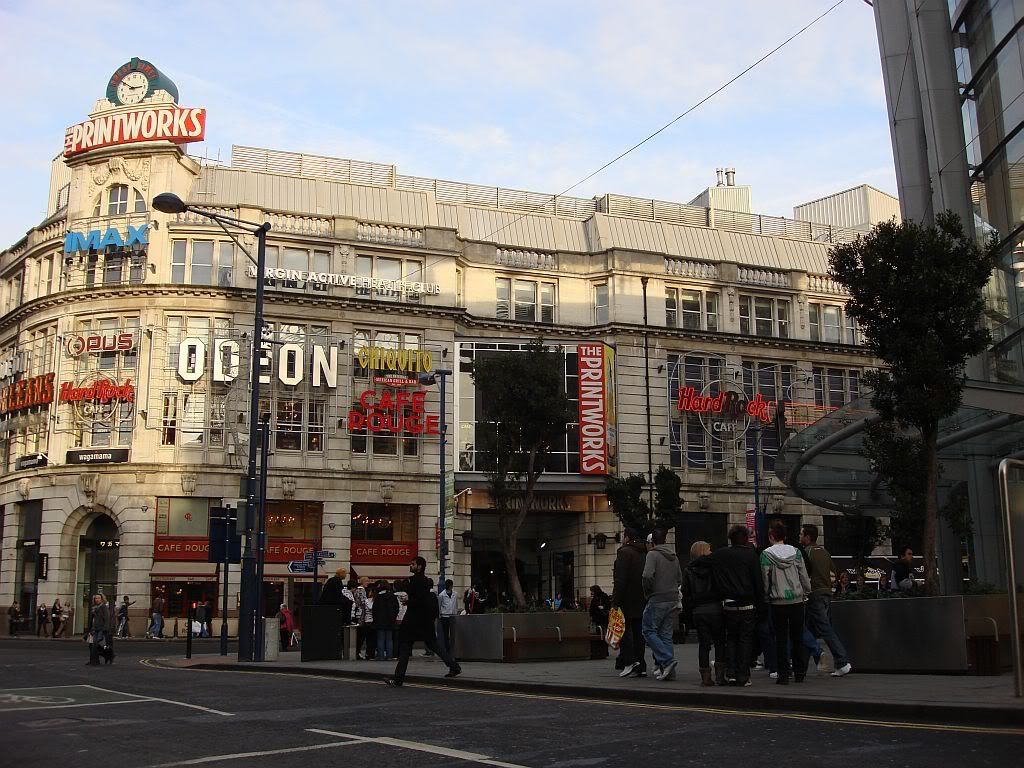
The Old Boars Head sat on the site of the Printworks on the corner of Withy Grove and Corporation Street. It was said (by the eccentric, murky, but seemingly knowledgable, William Connell in Underground Manchester) to be one of the many old Manchester pubs that were part of the city's secret tunnel network [2]. Seen in 1895 and 1906 in these archive images, the Old Boars Head lasted until the 1920s when Kemsley House later to become Thomson House and Maxwell House, the newspaper offices, were built. Today this building houses all manner of popular but soulless chain bars, restaurants and nightclubs in the Printworks.
.

Printworks, Withy Grove, 2008. (c) markydeedrop at skyscrapercity.


THE OLD BOARS HEAD WAS AFACEING KEMSLEY HOUSE UP TILL THE BUILDING OF THE ARNDALE CENTRE
ReplyDeleteIt was a Tetleys house on the opposite side of Kemsley House (Printworks) it wasn't demolished till the Arbdale was built.
ReplyDeleteThe Crosby 9 Withy Grove 1920's
ReplyDeleteBirthplace of Manchester City F.C..
ReplyDelete21st May, 1894
The Sight of The Football League meeting and vote had been held in Manchester at the 18th Century Old Boar’s Head Hotel on the corner of Withy Grove and Corporation Street
At the League AGM Parlby spoke convincingly of the ambition, finances, and strength of the new club – it is vital to record that Parlby talked of this as a completely new club. It may have taken the best that Ardwick had to offer, but it tried hard to distinguish itself as a separate entity. This is why the football club has continued to record its foundation as 1894. Other clubs, most notably Manchester United, refer to their original formation as Newton Heath in 1878 (some two years before they were known to play football and 24 years before they became Manchester United), but their history is similar to City’s in that they reformed as United in 1902.
At the 1894 AGM Parlby used all his persuasive powers to impress the League committee. A newspaper profile of Parlby, written in April 1904, looked back on his contribution in that meeting: “On May 21st 1894, the day on which Queen Victoria opened the Ship Canal, Mr. Parlby applied for and gained admission to the Second Division. On that occasion he was accused of being eloquent, and there was something of that quality in a fine well remembered peroration in which he told the assembled dignitaries of the League that it would be the endeavour of those associated with the club to whose name the club bore. A final hint that the League might add to the gaiety of the city was done. Without doubt it was largely a matter of personal influence.”
That statement makes it totally clear that the link between the pride the city was feeling in connection with the Queen’s visit and the opening of the Ship Canal was seen by Parlby as a significant factor in Manchester City’s own history. For this reason, the view that City are Manchester’s side has existed ever since the name was first chosen.