Pubs of Manchester

All pubs within the city centre and beyond.
A history of Manchester's hundreds of lost pubs.

Showing posts with label - Breweries. Show all posts

Sunday, 10 July 2011

Walker & Homfrays, Salford

Walker & Homfrays, Maine Road, Moss Side.

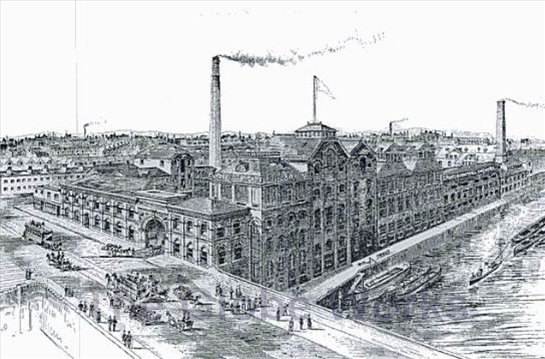
Walker & Homfrays of Salford was registered as a brewery in 1896 (though appears to have been in existence earlier than that) and was bought out by Wilsons of Newton Heath in 1949.  In 1929 Walker & Homfrays themselves had bought up the Creeses Brewery in Hyde. The sign on the Main Stand roof at Maine Road contains the line "Beer is the Best" - agreed.


The Crown (now the Deansgate), Deansgate. (c) www.northmanchester.net/content/view/99/2/.

Former Walker & Homfrays houses in town include the Ancoats Hotel, Waterloo, Frascati and the recently lost White House - the only one still standing is the Deansgate, formerly the Crown.  History of the brewery is scarce, but we do know that it was located at the Woodside Brewery, Wilmslow Street, off Eccles New Road.

Walker & Homfrays beer mat. (c) www.calvert-beermats.com.

Thursday, 8 July 2010

Groves & Whitnall, Regent Road, Salford

Something of a Manchester institution even today, despite ceasing to exist almost 50 years ago, Groves & Whitnall were at one time - towards the end of the 18th century - probably Manchester's favourite brewer. There is much to tell about their Regent Road Brewery, just over the River Irwell from Castlefield in the south west of the city centre. However, the wonderful website that meticulously records the long history of this proud firm does it more justice than we could - www.grovesandwhitnall.co.uk.

Groves & Whitnall Brewery, Regent Road Brewery. (c) www.grovesandwhitnall.co.uk.

So, very briefly, the excellently named William Grimble Groves and his mate Arthur William Whitnall were chemists and set up a vinegar works on Blantyre Street (where Jacksons Wharf is nowadays). William Peer Grimble Groves (the father) helped the two purchase the Bathe & Newbold Regent Street Brewery in 1868 for £9,000, and over the next 30 years the two built up the new Groves & Whitnall empire into a £1m company with 591 licensed houses. This was done mainly on the back of truly excellent ale after they employed king brewer Charles Henry Hill from the small Beaumont & Heathcote brewery in Chorlton-upon-Medlock. In fact, Hill was employed after Whitnall personally tasted all the available beers of Manchester and found Beaumont & Heathcote's the most outstanding!

Groves & Whitnall C Ale. (c) http://barclayperkins.blogspot.com.

They were proud of their ale at Groves & Whitnall's. Their bottled 'C Ale' is descibed as thus: "Burton itself cannot produce anything which, in its class, is superior to our Bitter Beer. Our famous 'C' ale is similar to the best Burton 'Mild'. Our strong Old ale or 'Barley Wine' stands pre-eminent and apart from all others, and our 'Special' Ale in bottle is fittingly described by its title" [1].

Groves & Whitnall Brewery, Regent Road. (c) www.grovesandwhitnall.co.uk.

The company floated publicly in 1899 and acquired Cronshaw's Alexandra Brewery. Whilst growth slowed due to the First World War when the company's fleet of delivery vehicles were commandeered for the war effort, the Regent Road Brewery was hit even worse in the Second World War. The brewery suffered terrible bomb damage which took years to recover from but further acquisitions in the 1950s saw Groves & Whitnall become an attractive proposition and they were bought by the larger Greenall Whitley Brewery in 1961. Just 10 years later and Greenall Whitley closed the Regent Road Brewery and the Groves & Whitnall name became largely consigned to history [2].

Groves & Whitnall Brewery, bomb damage in WWII. (c) www.grovesandwhitnall.co.uk.

The name lives on though, in the form of a few pubs in Manchester which still sport the Groves & Whitnall name. An example is the Chapel House in Dukinfield, east Manchester, which although now a Joseph Holt's house, proudly displays 'GROVES AND WHITNALL ALES AND STOUTS'. Lost Groves & Whitnall pubs of Manchester include the Oddfellows Arms, Welsh Harp, Royal Oak, Railway Inn and Rose & Crown.

Chapel House, Dukinfield, 2005. (c) breweryhistory.

Groves & Whitnall Brewery, Regent Road, Salford. (c) HarryM at the Salford forum.

More, much more at the website: www.grovesandwhitnall.co.uk.


Groves & Whitnall Brewery, Regent Road, Salford. (c) HarryM at the Salford forum.

Wednesday, 16 June 2010

Threlfall's Brewery, Cook Street, Salford


Threlfall's Brewery, Cook Street. (c) breweryhistory.

John Mayor Threlfall of Liverpool purchased their Liverpool brewery from Lupton and Adamthwaite in 1861 and Threlfall's became a registered brewer in 1888. In around 1895, the Blue Lion pub on Cook Street in Salford (previously the White Lion and Apollo) was demolished and another Threlfall's brewery built in its place. In 1961 Chesters merged with Threlfall's and the Salford site became Chester's and Threlfall's brewery. Whitbread took them over in 1967 and brewing continued on the site until around 1999. The grade 2-listed, fine brick building is now the Deva Centre, an urban business village.

Threlfall's Brewery, Cook Street. (c) breweryhistory.

Threlfall's brewery, aerial view. (c) webaviation.

The Church Inn, pictured below, backed onto the Threlfall's Brewery so may have been considered its brewery tap. You can see the resemblance between the Church Inn and the recently lost Hat & Feathers in both its siting and livery.

Church Inn, Chapel Street. (c) Ven16 at flickr.

Still standing pubs in Manchester that were Threlfall's houses in the past include the Lass O'Gowrie and the Land O'Cakes, as seen below by the old glass work and signs that used to adorn the pubs, plus the Crown & Anchor (Cateaton Street), White Lion and the City. Lost Threlfall's pubs of Manchester include the just-demolished Hat & Feathers and Red Bull (both Mason Street), Sir Ralph Abercrombie (Great Ancoats Street), Mechanics Arms, Crown & Sceptre, Gunsmiths Arms, Exile of Erin (Naples Street) and Old Lancashire Hounds.

Threlfall's Brewery Co. glass. Lass O'Gowrie. (c) breweryhistory.

Threlfall's Brewery Co. sign. Land O' Cakes. (c) breweryhistory.

Friday, 11 June 2010

Joseph Holt Derby Brewery, Empire Street

We make no apologies for championing Joseph Holt's beer and proclaiming it the finest pint in town. It's famously cheap, plentiful, proudly Mancunian, and above all, bleedin' lovely. For many Mancunians (including us), Holt's was their first proper pint, in the days when pints were priced in pence, and there are many locals who "won't drink owt else." Whether it's a thirst quenching pint of bitter, a leisurely session on the Dark Mild, or a chilled bottle of one of Holt's many fine premium offerings, you can't go wrong with Joey's (unless you're a lager drinker, in which case it's the Diamond or Crystal). Here's the story of Manchester's finest brewer, as told in a nice piece in The Changing Face of Manchester [1].


Joseph Holt. (c) andrewsvirtualbrewery.

In the 19th Century beer production in Manchester was lucrative to both the economy and the city's social well-being. The government as a whole was able to claim nearly a quarter of its revenues, at the time, from the excise duty levied on beer. The rise in the number of public houses steadily grew and the people of Manchester enjoyed frequenting them as a place to unwind, especially after a hard day's physical labour in one of the city's many mills or factories.

Raised the son of a weaver in the small textile village of Unsworth, Joseph Holt was attracted to the business opportunity offered by the burgeoning city of Manchester and took his first job as a carter at Harrison's Strangeways Brewery. Holt married a schoolteacher with an astute mind for business, and their first brewery in 1849 was a small building behind the Butchers Arms on Oak Street, now the Wheatsheaf. By 1855 they had moved to the Ducie Bridge Brewery where Holt would lend money to publicans in return for 5% interest and the sale of his beer. In 1860 Joseph Holt had built a brand new brewery, the Derby Brewery on Empire Street in Cheetham Hill half a mile north of the city centre, where the it still stands and operates from today.

The Joseph Holt Derby Brewery, Empire Street. (c) quaffale.

Despite the deep depression of the early 1860s, due to the Lancashire Cotton Famine brought on by the American Civil War, Joseph Holt bravely changed his strategy. Instead of selling beer at wholesale prices, he decided to open his own managed public houses, selling beer at retail prices. In 1882, Holt handed control of the business to his son, Edward Holt, by which time the family company already had 20 pubs to their name. Edward Holt quickly established himself as a successful entrepreneur, and, as did many figureheads within the brewery trade, he turned his hand to local politics. Of greatest significance was his work with the Council to bring soft water to the homes of the people of Manchester from the Lake District, via the 70 miles of pipeline, a source that is still used today. This achievement saw him elected as Lord Mayor of Manchester in 1908, a decision that sparked much controversy with his links to the brewery trade. However, the Manchester public held a different view and the was re-elected for a second term.

Chief Executive Richard Kershaw in the brewery. (c) citylife.

For over 150 years, there have been few changes to the original brewing process at the Derby Brewery. The brewery itself has retained its traditional style, although all of the plant has been replaced and expanded over the years, and where necessary modern high-tech equipment is used. The company sources whole cone hops from England along with the best quality English malt, to being drinkers a choice of beers each with their own unique taste. The range of bottled and draught beers produced by Joseph Holt can be enjoyed in one of the 130+ Holt's houses in and around the Greater Manchester area, but as far afield as Southport and Blackpool. Holts houses within our boundary are: Ape & Apple, Crown & Anchor, Crown & Cushion, Derby Brewery Arms and Old Monkey, with the Eagle Inn and Bricklayers Arms just outside, in Salford (special mention to for our local, the Volunteer).

Volunteer, Cross Street, Sale. (c) garstonian at flickr.

The bottled ales have been particularly successful in winning prestigious awards within the brewery industry and with major UK retailers. A famous name on the streets of Manchester, Joseph Holt was voted one of the city's greatest ever business leaders by Manchester Evening News readers.

Holt's bottle premium bottled ales. (c) joseph-holt.

Joseph Holt has supported local charities since its early beginnings, in particular the Christie Hospital, the largest single-site cancer research and treatment centre in Europe. In 1914 Sir Edward Holt helped raise funds to purchase radium for the Manchester and District Radium Institute, later named the Holt Radium Institute in his honour, which finally amalgamated with the Christie Hospital in 1932. When Sir Edward's son, also Edward, took over the business, Holt's support of Christie's increased. When Sir Edward's wife, Lady Margaret, died in 1996, she left Christie's £7 million of her shares in the brewery. Joseph Holt has continued to support Christie's, even naming a beer in the hospital's honour. In 1999, during Holt's 150th year in business, its customers and staff raised £301,000 to upgrade the Outpatients Department at Christie's. This resulted in the outpatients entrance being named the Holt Entrance. No group or organisation has done more for Christie's cause, and this has been achieved largely through the loyalty and support of all Holt's customers. There are few family brewers left in the UK today; most have been swallowed up by the giants of the industry. Holt's is one of four that have survived in Manchester, and its enduring success can be attributed to nothing more than a well-run company serving its customers with quality product.


The Christie is proposing to build a new wing at Hope Hospital in Salford in order to make it considerably more convenient for people to receive treatment. This building work will commence in October 2009 and be completed in early 2011. Holt's are targeting to raise £250,000 to provide the reception area for this new treatment centre. It will be known as The Joseph Holt Reception Area. For every £1 raised then the Company will donate £2 through both the Edward Holt and Peter Kershaw Trusts. To donate follow this link.


1. The Changing Face of Manchester Volume 3. At Heart (2007).

Sunday, 16 May 2010

Chesters Brewery, Ardwick & Salford


Threlfalls-Chesters Brewery, Salford, 1990. (c) deltrems at flickr.

Chesters had a long, proud history in Manchester, brewing from 1830 to 1999. They were originally based at the Victoria Brewery, Hyde Street, Ardwick. The brewer moved to the Ardwick Brewery in 1852 as depicted here just after it opened. In 1961 Chesters merged with Threlfalls of Salford and the Ardwick Brewery was demolished in 1966, but not before it was snapped in 1964, showing the Britannia Inn on site. Whitbread soon took over the Threlfalls-Chesters brewery and for a few decades, both ales were brewed in Salford where the brewery bore both names. Chesters bitters, milds and stout were brewed at a number of Whitbread sites towards its end, then contracted to Burtonwood and Everards, but sadly all production stopped in 1999 [1]. I remember our old granddad used to warn us of the dangers of Chesters Mild, saying it could turn you into a "Chesters case". Not sure what he meant by this, but the mention of Chesters Mild to drinkers of a certain age often brings forth a few interesting tales.

Threlfalls-Chesters Brewery tower, Salford, 1990. (c) deltrems at flickr.

Like Kays Atlas, the original Chesters Brewery in Ardwick was close to Manchester City Football Club, the brewer part-owning the Hyde Road stadium. Hyde Road's first seating area was paid for in part by Chesters in 1888, who funded 1,000 seats in return for being the sole distributor of alcohol in the stadium (sounds like a good idea; maybe one of Manchester's fine breweries fancy supplying us with decent ale at City, instead of the undrinkable John Smiths Smooth, Fosters and Singha?). Such was the close link between club and brewers, A.F.C. Ardwick (later to become MCFC) were nicknamed 'The Brewerymen'. The Crown & Cushion at the top end of Corporation Street was a Chesters house, and the brewery paid for its rebuild in the late Victorian period. Other old Chesters houses in town still remaining include The City, Oxnoble, Crown & Anchor and the Sir Ralph Abercromby.

Chesters Brewery wagon. (c) paulanderson.

Friday, 30 April 2010

Cronshaws Brewery, Erskine Street, Hulme


Location of Cronshaws Alexandra Brewery, Erskine Street. (c) googlemaps.

To the south of the city centre in Hulme between the main arterial routes of Chester Road and Princess Road was Cronshaws Alexandra Brewery on Erskine Street (the Platford and the Three Legs of Man sit on the junction of Erskine Street and Stretford Road), also facing onto Drayton Street. The map these days shows how these streets are close by but don't meet, so it looks like the development of Hulme changed the routes of these streets somewhat.

Erskine Street and Drayton Street. (c) googlemaps.

Cronshaws Alexandra Brewery, with a distinctive 120-foot high brewhouse tower, was built in 1872 by local architect James Redford. The architectural style of the brewery was described by The Builder as being "early Lombardian Gothic"; Redford used stone dressings, ornamental brickwork and panels of glazed green and red bricks to enliven the tower [1]. On 8th September 1899 Groves & Whitnall, a giant brewer in Manchester at the time, purchased the Alexandra Brewery and their tied houses. Mr W. S. Cronshaw was kept on as manager of the brewery and nine months later accepted a seat on the board of Groves & Whitnall [2]. This 1901 photo shows the Alexandra Brewery on Drayton Street just after it had changed hands from Cronshaws to Groves & Whitnall. Interestingly the photographer marked a boundary on it, possibly the Manchester-Trafford border? A 1965 photo shows the ornate buildings and tower more clearly.

I don't think there are any surviving pubs showing the Cronshaws signage, hardly surprising, over 110 years since it ceased to exist. However, we do know the Deansgate was once a Cronshaws house as was the Welsh Harp on Lees (Laystall) Street. The Kings Arms in Salford, a cracking boozer just over the river outside our boundary, was built by Schofield Cronshaw the family. Old Cronshaw bottles are highly collectible these days due the hand and arrow Cronshaws trademark as shown on the c.1910 bottle:

Cronshaws hand and arrow bottle. (c) Igor at archery-interchange.net.

Thursday, 29 April 2010

Hardy's Crown Brewery, Renshaw Street, Hulme

Hope Inn, Stockport. (c) Breweryhistory.com.

Hardy's Crown Brewery was in Hulme, just to the south of the city centre. Shown in these three 1964 photos, the brewery may already have ceased production, as the buildings were demolished in 1965 after the brewery was bought up by United Breweries in 1962 [1]. The first photo is described as the Crown Hotel and Brewery, and this 1964 pic shows the public house that was incorporated into the brewery. Renshaw Street and South Street are no longer on any maps so I suspect this area may have been swallowed up by some housing development or other.

Hardy's Well, Rusholme. (c) Breweryhistory.com.

The only lost pub we know of as a Hardy's house was the St Andrews Tavern in Norton Street near London Road Station. However, a number of old Hardy's pubs in Greater Manchester still display the signage, the Hope Inn in Stockport still proudly bearing the whole name. Possibly the closest boozer to its old brewery is the Salutation ("the Sally" in Hulme).

Salutation, Hulme. (c) cia-msa.com.

Hardy's Well in Rusholme at the end of the "Curry Mile" is actually named after the brewery, though it was Birch Villas in the days when some of us used to sup there pre-match. Over the road is the grim Huntsman with its white stone Hardy's Crown sign.

Huntsman, Rusholme. (c) Breweryhistory.com.

Heading further south, one of the finer looking pubs in Sale is the Bulls Head with its unmissable Hardy's signage on the A56. The Bulls has reopened recently to much fanfare in the real ale community, though every time we've been in neither the ale or the crowd has been much to write home about, so we stick to the ever reliable Volunteer up the road - amongst the many fine Holts houses in Greater Manchester, we reckon this must be right up there.


Bulls Head, Sale. (c) Breweryhistory.com.

Finally, The Stonemasons, further south still in Timperley was actually rebuilt in 1926 but you wouldn't know it looking at the old pub, as shown here from the Trafford Archives - the licensing magistrate demanded that the new pub retain the features of the one they knocked down - including the Hardy's masonry.

Stonemasons Arms, Timperley. (c) Breweryhistory.com.

Monday, 26 April 2010

Kays Atlas Brewery, Grey Street, Ardwick

Location of Kays Atlas Brewery, Grey Street, Ardwick. (c) googlemaps.

Kays Atlas Brewery was a mile or two east of the city centre in Ardwick on Grey Street off Hyde Road. The brewery is seen in a sad state in these 1969 and two 1971 photos with its windows put through. In its heyday the brewery would have been within earshot of Hyde Road, Manchester City Football Club's first proper stadium, which stood on Bennett Street just north-west of Grey Street. Once holding 40,000, the stadium was a cramped affair and City had moved onto the 80,000-capacity Maine Road in Moss Side by 1923.

Location of old Kays Atlas Brewery, Grey Street, Ardwick. (c) googlemaps.

The Stockport and London-bound west railway line passes over Grey Street here, and under the bridge a few yards from where the old brewery stood is where the Manchester Martyrs attacked and killed a copper in the Fenian Ambush of 1867. A memorial for the three Fenians sits here, commemorating the last public hangings in Manchester.

Fenian Ambush. (c) wikipedia.

Only one former Kays Atlas house stands in town, the Castle on Oldham Street, and lost Kays Atlas houses include the Greengrocers Arms in Blossom Street and the Brown Bull, Malaga Street. This is the only old Kays Atlas house I can find for the moment, and sadly the pub is unidentified:

Unknown Kays Atlas pub, Manchester. (c) curlywurly at rootschat.

Kays Atlas was acquired by Robinson's of Stockport in 1929, but Kays can still be seen in the odd pub around Manchester today. For example the fine old tiled frontage at the Forresters Arms on Ashton Old Road in Gorton:

Forresters Arms, Gorton, 2005. (c) BreweryHistory.

On the old Bankfield Hotel on Mottram Road in Hyde, the "K" and the "Beast and Key" Kays family emblems are still seen:


Bankfield Hotel, Hyde, 2005. (c) BreweryHistory.

The most obvious example of Kays Atlas tiling can still be seen in the city centre - the classic brown frontage of the Castle on Oldham Street was installed by Kays Atlas about 100 years ago, and fittingly, it's now the only Robinson's tied house in town.

Castle, Oldham Street. (c) Pubs of Manchester.


Kays Atlas bottle. (c) BruceMobley.com.