Pubs of Manchester

All pubs within the city centre and beyond.
A history of Manchester's hundreds of lost pubs.

Monday, 7 February 2011

Dock & Pulpit / Borough, Bank Place

Dock & Pulpit, Bank Place, Salford. (c) novaloca.com.

Today's apparent non-story about the Mark Addy being knocked down by Salford Council due to their blanket compulsory purchase order of property in the area brought up this forgotten pub, hidden away off Chapel Street on Bank Place.  The Dock & Pulpit, formerly The Borough, has only been closed since the late 1990s, and is meant to be being either converted into two apartments, demolished and new flats being built in its place, or even converted into offices or a bar/restaurant [1].  Since the above photo was taken the Dock & Pulpit has deteriorated in appearance and remains empty.

Dock & Pulpit, Bank Place, Salford. (c) Eddie_Manchester at flickr.

The Borough Arms beerhouse opened behind St Philip's Church and next to the County Court in about 1860, kept by John Norbury who also gained a billiard licence in 1863.  In 1890 the Altrincham Brewery Company.  sold the pub to Chesters Brewery before it went to Whitbread then Burtonwood Brewery in 1977.


Borough Arms, Bank Place, 1990. (c) deltrems at flickr.

In the 1975 guide the Borough is described as a quiet (empty), two room pub with good cask Trophy [2]. The Borough's last owners were Jo and Andy Davies, before it reopened as the Dock & Pulpit in 1994 for a final handful of years, named after the grand building in Encombe Place which it abuts [3].

Salford County Court, Encombe Place. (c) globrix.com.

1. www.novaloca.com.
2. The Manchester pub Guide, Manchester & Salford City Centres (1975).
3. Salford Pubs - Part One: The Old Town, including Chapel Street, Greengate and the Adelphi, Neil Richardson (2003).

Sunday, 6 February 2011

Mosley Arms, New Shambles

Mosley Arms, New Shambles. (c) Alan Godfrey Maps [1].

The Mosley Arms stood on New Shambles, now the lower part of Southgate.  In the mid 1880s this area was home to Deansgate Shambles, a large undercover market area complete with the fruit & veg Deansgate Arcade Market.  Just off Lower King Street (now King Street West), the Mosley Arms was one door down New Shambles, opposite the market's Weights and Measures Office, which stood where San Carlo (Maxwells) is today [1].

Former location of Mosley Arms, New Shambles (Southgate). (c) googlemaps.

1. Manchester City Centre 1849, Alan Godfrey Maps (2008).

Barons Bier Keller, Oxford Street

Possible former location of Barons Bier Keller, Oxford Street. (c) googlemaps.

As the name suggests this was an attempt at a German theme bar, similar to the Bier Keller on Piccadilly and the old Beer Kellar on Wood Street.  The lads from the 1975 Manchester Pub Guide gave it a scathing review - in German obviously - bemoaning the high prices, cheap decor (with no German influence), crap beer (Youngers Scotch, Tartan, Double Diamond) and mainly teenage clientèle [1].  It was on the left side of Oxford Street, possibly in the block shown, but exact location is unknown.

1. The Manchester Pub Guide, Manchester & Salford City Centres (1975).

Olivers Pub Bar, Oxford Street

Apparently this place was formerly part of Fagins (Rafters) night club.  Olivers Pub Bar was open during the day and was a large drinking den with Youngers Scotch bitter, keg Tartan, a "quiet oasis..." and an additional saloon-style bar offering drinkers "compartments with a privacy rarely found in pubs today" [1].  Rafters was thriving throughout the the '70s so it sounds like this place was entirely separate from the club.

1. The Manchester Pub Guide, Manchester & Salford City Centres (1975).

Thursday, 3 February 2011

North Westward Ho!, Pomona Dock


North Westward Ho!, Pomona Docks. (c) Chris Bluer / Jud Evans [1].

South of Manchester city centre lies Pomona Dock, seen here in 1925, a reminder of the once thriving Port of Manchester at the end of the Manchester Ship Canal.  While the main docks have been regenerated into Salford Quays, with the BBC moving significant parts of their programming to the site, the smaller Pomona Dock further up the canal towards town remains largely derelict due to ground pollution.  

Pomona Docks. (c) oceangateway.com.

In the 1970s, Pomona Docks was home to one of Manchester's strangest public houses, the North Westward Ho! pubship.  The North Westward Ho ship (b.1938) was bought by Jud Evans in 1972, and after permission was granted for a spot and for an alcohol licence from the Manchester Ship Canal Company and the Licensing Magistrates, the ship was sailed up from Cornwall, down the Ship Canal and birthed at Pomona.  

North Westward Ho, Pomona Docks. (c) Chris Bluer / Jud Evans [1].

A 12-month refit saw her kitted out as the North Westward Ho!, a plush bar and restaurant, offering six bars, Bass ale, late licence and disco - though note the strict dress code!  The success of the ship led to a comet jet being purchased from the RAF and parked next dor to act as an overflow venue, complete with dancefloor [2].


North Westward Ho!, Pomona Docks. (c) Chris Bluer / Jud Evans [1].

After a good decade, the North Westward Ho! closed and was eventually broken up in 1996 [3].  A regular at the Westward Ho and local businessman, Chris Bluer, supplied the above images from a 1973 newspaper cutting [1].


North Westward Ho!, Pomona Docks. (c) Chris Bluer / Jud Evans [1].
1. http://evans-experientialism.freewebspace.com/westward_ho_cutting_1973.htm. 
2. http://evans-experientialism.freewebspace.com/westwardho.htm. 
3. http://www.teesships2.freeuk.com/050403westwardho.htm.

Wellington, York Street

Wellington, York Street, 1968. (c) David Pryer with permission.

The Wellington was hidden away off Grosvenor Street on York Street, and was closed in 1963, an old Threfalls house [1].  It's pictured above in 1968 thanks to David Pryner.  However, the Wellington appears to have had a renaissance as it received rave reviews in the 1975 Manchester Pub Guide [2] and was photographed here in 1973 for the archives.

The Wellington is described as a reminder of the Manchester drinking houses of a long-gone age, with nicotine stained rooms and a cramped corner bar.  Locals would moan about "bloody students" and the ale was excellently kept Whitbread, Tetley and "Chesters fighting mild" (the infamous dark mild that resulted in "Chesters cases").  The Wellington even had a football room - football cuttings covered the wall, a bearded George Best was on the ceiling and there was table football.

Sounds like a cracking boozer - shame it was deceased not long after this glowing 1975 review (according to a hand-written note in the Pub Guide) [2].  Today in this area of All Saints, we have The Pub (left) and Sand Bar (far right) and the Wellington stood down York Street on the right, on the site of the new building behind the no entry sign.

Former location of Wellington, York Street. (c) Google 2011. View Larger Map..

1. The Old Pubs of Hulme & Chorlton-on-Medlock, Bob Potts (1997).
2. The Manchester Pub Guide, Manchester & Salford City Centres (1975).

Devines Wine Bar, Princess Street

The only thing known about this place is that it was a "barn-like wine bar" on Princess Street.  In the 1975 Manchester Pub Guide it didn't get much of a write-up.  It was apparently failing to attract attention despite the 43 wines and three champagnes on offer - no beer, see [1].
Could Devines have been O'Shea's... Joshua Brooks... Overdraught/Rendezvouz?...

1. The Manchester Pub Guide, Manchester & Salford City Centres (1975).

Tuesday, 1 February 2011

Cheshire Tavern, Bridge Street

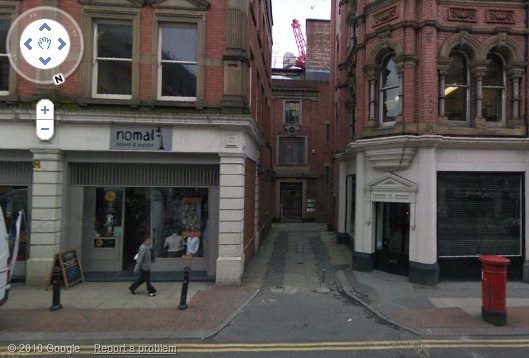
Former location of Cheshire Tavern, Bridge Street, 2010. (c) mrrobertwade (wadey) at flickr.

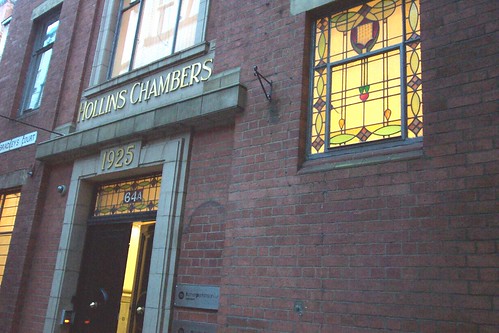
Down a little alleyway off Bridge Street, just a few doors down from Sawyers Arms, is this grand but hidden building.  The sign 'Hollins Chambers 1925' shows it was the old offices of Hollins law firm [1].  Before the chambers were built, the Cheshire Tavern stood here, run by George A. Scudamore in the mid 1800s [2].  


Former location of Cheshire Tavern, Hollins Chambers, Bridge Street, 2010. (c) googlemaps.

The Cheshire Tavern's address was (and the chamber's is, these days) 64a Bridge Street, but the shot below shows a sign for Bradleys Court.  This is one of Manchester's modern-day hidden streets, as it's not on (m)any maps, nor is it visible from the main street. 

Bradleys Court, off Bridge Street. (c) radaris.com.

1. http://www.thelawyer.com/manchester-merger-takes-georgian-hq/78674.article.
2. Manchester City Centre 1849, Alan Godfrey Maps (2008).

Gaetanos, Back Piccadilly

Gaetanos, Back Piccadilly. (c) googlemaps.

Not too sure on the spelling of this one, but on Back Piccadilly between Oldham Street and Tib Street was a club called 'Gaetanos'.  It was on the left hand side, possibly where this door was, opposite Sachas hotel (and its horrible Fridays bar) and adjacent to where the Bet Fred bookies is today.  Thanks to Ted Stockton for this (and more) information.

Gaslight Bar, Aytoun Street

Gaslight Bar, Aytoun Street. (c) Manchester Pub Surveys [1].

The Gaslamp is Manchester's newest bar over on Bridge Street, but one of Manchester lost bars was the Gaslight Bar in the old Grand Hotel on Aytoun Street.  The Gaslight is described in the mid 1970s as "a smaller, quieter bar, very suitable for taking a new impressionable acquaintance.  Gin and tonic is more the order of the day here" [1].  The Grand Hotel was converted into 'The Grand' flats in 1988 [2] and remains an impressive site, just around the corner from the Waldorf or passing on the tram.

The Grand, former Grand Hotel, Aytoun Street. (c) philipjames.

1. The Manchester Pub Guide: Manchester & Salford City Centres, Manchester Pub Surveys (1975).  

Saturday, 29 January 2011

Manhattan, Spring Gardens

Manhattan Sound, Spring Gardens. (c) Debbie at MDMA.

Manhattan or Manhattan Sound was a small club, possibly a basement venue, on Spring Gardens where occasionally local bands like The Smiths [1] and Simply Red [2] cut their teeth (note the amusing John Bull story).

Manhattan, Spring Gardens. (c) dubwise-er at MDMA.

We've heard that it may have been lost to an underground car park, but as below, it may also have been on the corner of Spring Gardens and Fountain Street, now offices.


Possible former location of Manhattan, Spring Gardens. (c) googlemaps.

1. http://www.mdmarchive.co.uk/archive/showartefact.php?aid=5245&vid=355.
2. http://www.mdmarchive.co.uk/archive/showartefact.php?aid=6999&vid=355.

Thursday, 27 January 2011

Name that pub


"Manchester, 1977" is all we've got to go off.  The photo comes from John Bulmer as featured on the How to be a Retronaut site with the now identified Broadway Inn, Ordsall, so may be Ordsall as well...


(c) John Bulmer at How to be a Retronaut.

Wonder who this smart looking fella is:


Tramps, Princess Street

Tramps, Princess Street. (c) dubwise-er at Manchester District Music Archive.


Tramps club on Princess Street, next to the Cyprus Tavern as the flier shows, hosted the Frantic Elevators in November '82.  Seeing as the Frantic Elevators were Mick Hucknall's original band, it would be rude to say the venue was aptly named.  Sounds like Tramps was suitably scruffy though: "it made the Cyprus look like a veritable palace [1]."  (Interestingly, there is mention of Tramps on a flier in the closed Rowntrees venue on Brown Street as shown in this entry for Shorts Ltd.).


Former location of Tramps, Princess Street. (c) googlemaps.


1. http://www.mdmarchive.co.uk/archive/showartefact.php?vid=242

Shorts Ltd., Brown Street

The sign above the bar in Shorts Ltd. on Brown Street read "Shorts Ltd., 1672" - unlikely to be its Est. year!  Another themed pub which seemed to be all the rage in the 1970s, though what that theme was is unclear, as Shorts had riding gear, horses brasses and a stag's head, as well as bars named after Micawber and Dickens himself.  It was a John Smiths house, offering bitter, mild plus keg Courage Tavern and Harp to accompany the fruitie, TV table tennis, pool table and jukebox [1].  The exact location of Shorts Ltd. on Brown Street is unknown at present.  Here's a 1973 photo looking down Brown Street towards King Street from King Street for now (just seen the Post Office on the right).  Could this 1973 'Rowntrees' (not the Hanging Ditch Rowntrees) in the Westminster Buildings have later become Shorts Ltd.?  Note the sign which says "Rowntrees is now closed... Tramps" (Tramps was a club over on Princess Street).

1. The Manchester Pub Guide, Manchester & Salford City Centres (1975).

Footlights Bar, Aytoun Street

The Grand, former Grand Hotel, Aytoun Street. (c) philipjames.

Another bar in the old Grand Hotel on Aytoun Street, Footlights Bar was rebuilt in 1969 after a fire destroyed it.  Only a couple of decades later and the hotel has closed, converted into 'The Grand' apartments in 1988 by Ian Simpson Architects [1].  The Gaeity Bar was the main non-residents bar and it, like the Footlights Bar, was blessed with pristine loos.  The gents had hot water, plugs, towels, mirrors and shaving sockets - clearly an extravagance in the downtrodden '70s [2].

Footlights Bar, Aytoun Street. (c) Manchester Pub Surveys [2].

2. The Manchester Pub Guide: Manchester & Salford City Centres, Manchester Pub Surveys (1975).  

Goblet Wine Bar, Mount Street

Another of the public bars in the Midland Hotel opened in around 1975, the Goblet Wine Bar (not to confused with Goblets Wine Bar on Bridge Street - now the Bridge) was a one-room basement bar.  A tiled staircase led down to a French-themed room with chequered tables, cane hatstands and waiter service.  Doesn't sound like one for the beer lover with champagne and wine the order of the day to accompany retro delicacies such as steak sandwiches or chicken-in-a-basket [1].

1. The Manchester Pub Guide, Manchester & Salford City Centres (1975).

Wednesday, 26 January 2011

Golden Eagle, Hardman Street

Former location of Golden Eagle, Hardman Street. (c) googlemaps.

On the left hand side of Hardman's Street (as it was known in the 1800s), just off Deansgate, was the Golden Eagle.  Where the small area of greenery is before the MEN building is Sidney Street leading to Tivoli Street, but in the 1800s it lead to the less exotic Thompson Street.  The Golden Eagle was one door past Sidney Street, placing it in the middle of this row of low hedges; the pub also had a rear entrance on Thompson Street [1].


Former location of Golden Eagle, Hardman Street. (c) googlemaps.

1. Manchester City Centre 1849, Alan Godfrey Maps (2008).

St Ann's Tavern, St Ann's Square

St Ann's Tavern was a basement bar on the square, and was possibly Horts or Ronnies in an earlier time [TBC].  It sounds like it was one of Manchester's first proper continental beer bars, with Carlsberg Hof, Heineken Special Export and bottled Lowenbrau, Kronenbourg, Reschs and Castlemaine on offer, as well as the more usual Tetley and Guinness.  There was an Italian bar billiard machine in St Ann's Tavern and next door was Henekey Inn steak and schnitzel bar [1].

1. The Manchester Pub Guide, Manchester & Salford City Centres (1975).

Alaska Bar & Café, Whitworth Street West

Former location of Alaska Bar & Café, Whitworth Street West. (c) googlemaps.

Located in Arch 69 on Whitworth Street West at the Hacienda-end of the street, Alaska was a pre-club bar in the 1990s.  This 1999 advert for Planet K (now Mint Club on Oldham Street) is the only real evidence of the existence of Alaska:  "Fat City at Alaska.  Heavyweight, pre-club warm up. 9-11pm. Free."  It lasted a few years longer than the Hacienda, Venue et al, but may have closed in the early 2000s and it's now Belvoir estate agents.


Alaska, Whitworth Street West. (c) MDMA.

Monday, 24 January 2011

Crescent / Brick House, Great Ancoats Street / Back Crescent

The Crescent, Great Ancoats Street, 1960s. (c) Neil Richardson [1].

The Crescent, an old Chesters beerhouse on Great Ancoats Street, is pictured here in 1959 on the corner of Tame Street, which used to run parallel with and just west of Every Street.  The vault was popular with "Chesters men" while the women used the lounge where Country & Western music would predominate.  Other beers on offer in this popular local in the '70s were cask Whitbread Trophy, Heineken and Guinness [2].  The Crescent later became the Brick House but was pulled down in 1986, after good innings of almost one and a half centuries - the earliest recorded beerhouse keeper was George Crossley in 1843 [1].  This part of Great Ancoats Street was widened in the late 1980s so the exact former location of the Crescent is not immediately obvious; the 1849 map of Higher Ardwick shows it was originally on the corner of Back Crescent and Mount Street, just set back from the main road [3].


Crescent, Back Crescent, Ancoats. (c) Alan Godfrey Maps [3].

1. The Old Pubs of Ancoats, Neil Richardson (1987).
2. The Manchester Pub Guide, Manchester & Salford City Centres (1975).
3. Upper Ardwick 1849, Alan Godfrey Maps (2000).

Royal Oak, Great Ducie Street

Royal Oak, Great Ducie Street. (c) Manchester Pub Surveys [1].

The Royal Oak was the original Boddingtons brewery tap with the new-build Brewery Tap / Brewers Arms replacing it, probably in the 1980s.  It was a quiet pub with outside toilets overlooking the brewery, frequented mainly by nearby workers at dinner time and blokes from the nearby hostel.  Despite this, it was highly rated for the superb and cheap Boddies beer [1].  These were the days when Boddingtons beer was a fine pint, highly hopped, more bitter than any other session ale, and a fine example of what is today sometimes referred to as 'Manchester Pale Ale.'

Former site of Royal Oak (& Brewery Tap), Great Ducie Street. (c) Google 2011. View Larger Map.

1. The Manchester Pub Guide, Manchester & Salford City Centres, Manchester Pub Surveys (1975).

Sunday, 23 January 2011

Bridge Inn, Pin Mill Brow

Former location of Bridge Inn, Pin Mill Brow. (c) googlemaps.

It's difficult to believe but here on Pin Mill Brow where Great Ancoats Street meets Ashton Old Road used to stand the Bridge Inn.  Seen here in 1958, it backed onto the River Medlock, hence its name, as seen here in 1958.  These photos from 1960 and 1964 show this Chesters pub that was still open as recently as 1975.  It was described in the Manchester Pub Guide as "standing in splendid isolation... a memorial to the old Chesters Brewery in nearby Ardwick... A traditional but tarnished house, it looks to be awaiting the pleasure of the demolition gang" [1].  As the 1958 photo shows, it was on the corner of Pin Mill Brow and Ancoats Island, which can still be seen on the old layout thanks to googlemaps.


Former location of Bridge Inn, Pin Mill Brow. (c) googlemaps.

1. The Manchester Pub Guide, Manchester & Salford City Centres (1975).

Jersey Lily, Jersey Street

Jersey Lily, Jersey Street, Ancoats, 1992. (c) Alan Winfield with permission.

The Jersey Lily estate pub was built in 1968 next to where an old Wilsons house, the Murrays Arms, once stood on the corner of Jersey Street and Kemp Street [2].  These days Kemp Street doesn't exist having been lost, first to the four storey council flats that popped up in the 1960s (as seen here and here) and then to more modern ones which again look doomed today.  The Jersey Lily was built to serve this council house development which included the huge but now condemned Ancoats high-rise flats on Wadeford Close, off Oldham Road.  The pub was named after the street on which it stood the and the sign depicts the 'Jersey Lily', the famous actress and lover of King Edward VII. 

Jersey Lily, Jersey Street. (c) The Manchester Pub Guide [1].

The Jersey Lily, popular with younger locals in the 1970s, was originally a Groves & Whitnall house, and in the '70s offered Greenall Whitley and Guinness [1]. By the time Alan Winfield visited in 1992, two Whitbread ales were on offer - Flowers Bitter and Boddingtons Bitter.  Judging from the old maps of Ancoats, Kemp Street was approximately where Jersey Street bends sharply left, so the Jersey Lily will have stood on the corner where there looks to be a pub-shaped gap.  I presume the second wave of council house building saw off the Jersey Lily in the late '90s as this canal guide from 1998 still refers to it.  

1. The Manchester Pub Guide, Manchester & Salford City Centres, Manchester Pub Surveys (1975).
2. The Old Pubs of Ancoats, Neil Richardson (1987).

Thursday, 20 January 2011

Bridge Inn, Fairfield Street

Former Bridge Inn, Fairfield Street. (c) googlemaps.

This oddly extended building on Fairfield Street, on the less-used approach to Piccadilly Station, looks like an old pub.  Lo and behold, it was, as this 1969 photo confirms, with the front extension unmissable.  It was the Bridge Inn, named after the dominating railway viaduct and bridge in the shadows of which it sits.  These two 1903 photos show the rear of the pub, and hint at the houses that once stood in this now derelict area.  It was a three-roomed house with a central bar, only the smoke room being fitted out in any comfort with carpets and soft seats.  In the 1970s the Bridge Inn was a rare example of a central Manchester pub with a busy billiards table.  Typical of the real ale desert that much of the city was in the '70s, the beer engines on the bar were for show only, and only keg Whitbread and Guinness was on offer [1]; a few years earlier Chesters was also served as the 1969 photo above shows.

1. The Manchester Pub Guide, Manchester & Salford City Centres (1975).

St Peter's Tavern, Peter Street

The St Peter's Tavern is described as a pleasant, quiet bar with a small shop-type frontage, situated between the Free Trade Hall and Deansgate (so probably where Bar 38 is now, in the same old block that housed the Gallery).  Great Northern Bitter was served by handpump and the rare sight of Watney's keg mild was also seen supped alongside wine by the bar-propping drinkers.  Modern decor plus jukebox, fruit machines and TV table tennis and the fact the St Peter's Tavern was bypassed by the Free Trade Hall and Opera House crowds, meant "this small, friendly, comfortable, warm tavern is hard to fault [1]."

1. The Manchester Pub Guide, Manchester & Salford City Centres (1975).

Pepys Sandwich Bar, Back Pool Fold

Pepys Sandwick Bar, Back Pool Fold. (c) Derek Parr with permission.

In the 1970s this odd little place tucked away on Back Pool Fold was perhaps Manchester's most exclusive public bar.  The sign outside Pepys Sandwich Bar, which used to be close to Sam's Chop House, read 'For Gentlemen Only' and the place only opened at dinner time.  Being in the financial centre it catered for the hard-working, hard-drinking City Gent and was standing room only for the sherry and Whitbread Tankard drinkers [1].  Derek Parr remembers Pepys having no seats, no tables, and no ladies (just one or two ladies behind the small bar).  There was a narrow shelf all round the wall on which which rest your drink.

1. The Manchester Pub Guide, Manchester & Salford City Centres (1975).

Oxford Road Station Bar, Oxford Road

Oxford Road Station, Oxford Road. (c) MEN.

In the '70s before the ugly new frontage was added in the 1990s, this British Rail bar was adjacent to the station entrance.  Situated in what is now just a shop, it offered ample seating in a semi-circular shape with views of platform 4 and beyond through large windows.  Worthington E and draught Guinness was available through "hole in the wall" taps for the thirsty traveller, as well a selection of cans [1].

1. The Manchester Pub Guide, Manchester & Salford City Centres (1975).

Wednesday, 19 January 2011

Butty Boat Bar, Mount Street

Midland Hotel, Peter Street. (c) earthinpictures.

This was the public bar of the Midland Hotel, entered either from within the hotel or by an outside entrance on Mount Street.  A loose canal connection was seen in the decor, with a few painted posts and teapots amongst the lounge style seats.  The 1975 guide mentions poor service and pricey beer with a bad selection of national keg brands, Worthington, Double Diamond, Youngers Tartan and Carling [1].  Its clientèle tended to be businessmen on expenses and couples.


Possible old entrance to Butty Boat Bar, Mount Street. (c) googlemaps.

1. The Manchester Pub Guide, Manchester & Salford City Centres (1975).

Trafalgar Buttery Bar, York Street

Trafalgar, York Street, 1990. (c) deltrems at flickr.

The Trafalgar was known as the Trafalgar Buttery Bar in the 1970s, was a small, quiet bar situated in the basement of the Trafalgar restaurant on York Street in the financial heart of town.  The decor was modern and tasteful with marble bar and high tables with stools around the walls; no fruit machines or jukebox either.  The Buttery Bar had pictures hung of a nautical theme - diving helmets, ships helms, etc.  Beer was reasonably priced with Tetleys, Double Diamond, Skol and Guinness on offer.  Amusingly, the 1975 pub guide compares the tasteful Traflagar with the garish Crown & Anchor on Hilton Street, which, 35 years on, is still moaned about by Manchester drinkers for its bizarre decor.  The Buttery Bar sounded like the place to go in the '70s for "the discerning drinker who wants a modern, pleasant place to sit, talk and drink without any distractions [1]."

1. The Manchester Pub Guide, Manchester & Salford City Centres (1975).

Piccadilly Hotel Plaza Bar, Piccadilly Plaza

Piccadilly Plaza Hotel. (c) Aidan O'Rourke.

Not really a place for the public these days, the bizarre looking Piccadilly Plaza hotel bar provided an expensive pint in comfortable surroundings for the public in the 1970s.  Piped music, air conditioning and the keg horror of Double Diamond and two strengths of Skol lager don't paint a positive picture.  Its main patrons were couples on an evening out in a posh setting (waiter service at weekends) [1].  Building of The Plaza was started in 1958 and was completed in 1965 and its renovation is detailed in this article by Manchester photographer Aidan O'Rourke [2].

1. The Manchester Pub Guide, Manchester & Salford City Centres (1975).
2. www.aidan.co.uk/article_piccadilly_plaza_renovation.htm.

Gaiety Bar, Aytoun Street

The Grand, former Grand Hotel, Aytoun Street. (c) philipjames.

The Gaiety Bar was the non-residents lounge of the Grand Hotel on Aytoun Street.  The grandeur of the old imposing 1867 building stems from its rebuilding in 1883 as a hotel, whilst retaining its original warehouse exterior.  The decor of the Gaiety Bar gave it an old, worn theatre bar feel including a model stage fire curtain and footlights, with old poster advertisements, theatre notices and pictures [1].  Apparently, formal gentlemen would mix with informally-dressed ladies in the Gaeity Bar, where the pricey beer on offer was Wilsons Great Northern Bitter, Worthington 'E', Double Diamond and Carlsberg.  The hotel was converted into The Grand, a residential development, by Ian Simpson Architects in 1988 [2].

Grand Hotel signs, Gaiety Bar, Aytoun Street. (c) Manchester Pub Surveys [1].

1. The Manchester Pub Guide: Manchester & Salford City Centres, Manchester Pub Surveys (1975).  
2. http://manchesterhistory.net/manchester/architects/mills.html.

Monday, 17 January 2011

Theatre Club, Kennedy Street

Kennedy Street (Theatre Club somewhere along on the left) (c) Dai O'Nysius at Panoramio.

On the same side of Kennedy Street as the trio of pubs, Waterhouse, City Arms and The Vine, about half way along, was the Theatre Club in the 1970s.  Ted remembers the Theatre Club opening late and also catering for drinkers when the pubs closed for the afternoon.  Stan Bowles, the maverick footballer was probably best known as a Queens Park Rangers player, but as most Mancunian football fans know, the lad from Collyhurst started his career at City.  Bowles was something of a regular at the Theatre Club, often using the club to play the fruit machines. 

Sunday, 16 January 2011

AG Club, Tib Street

Another old club discussed on the Man Mates forum by Angela and June, the AG Club on Tib Street was named after its owner, Arthur Griffiths [1].  Members all had their own keys to the AG Club in the 1970s when a fella called Stan ran it.  Its location has been confirmed as at the top end of Tib Street near Foundry Lane, on the right hand side going north.  Picture to follow.

1. http://manmates.proboards.com.

Ponderosa Club / Express Club, Oldham Road

Another newspaper club like the mysterious Crusader Club, the Ponderosa apparently became the Express Club, named of course after the Express Building.  June at Man Mates remembers it being behind the Express Building, just off Oldham Road, run by the Mancini family, and confirms it became the Express Club [1].  'Tigger' remembers "narrow stairs leading to a narrowish club (front window used to overlook New Cross / Oldham Road).  From the top of the stairs, bar and seating areas to the right, dancefloor and stage to the left [2]."  Could the Ponderosa have been in this row of buildings, possibly the black door on the right?  This suggests the club might have previously been the O'Connells Arms - can anyone confirm this?

Possible location of Ponderosa Club / Express Club, Oldham Road. (c) googlemaps.

1. http://manmates.proboards.com.
2. http://manmates.proboards.com.