Pubs of Manchester

All pubs within the city centre and beyond.
A history of Manchester's hundreds of lost pubs.

Sunday, 19 February 2012

Waverley Hotel, Eccles New Road


Waverley Hotel, Eccles New Road, Salford. (c) Salford Pubs of the 70s at flickr [2].

The Waverley Hotel building is still open for business on the corner of Thurlow Street and Eccles New Road, behind the monolithic flats that mark the very start of the M602.  Although unfortunately it's as a Chinese take-away rather than a public house these days.

New China Sea, former Waverley Hotel. (c) Google 2012. View Larger Map.

The Waverley Hotel opened in 1875 under Thomas Shepherd and advertised Threlfall's celebrated ales, Bass & Allsopp bitter, and Truman, Hanbury & Buxton stout, plus 'every accommodation for travellers and cyclists' [2].


Waverley Hotel, Eccles New Road, Salford, 1996. (c) Neil Richardson [1].

Threlfall's had the pub in the first half the twentieth century and it then passed to Whitbread in the 1960s.  The Waverley Hotel closed in 1995 and is pictured a year later, sadly boarded up, in Neil Richardson's fine book (Part Three) [2].


New China Sea, former Waverley Hotel, Eccles New Road, Salford. (c) Whose View.

2. Salford Pubs - Part Three: Including Cross Lane, Broad Street, Hanky Park, the Height, Brindleheath, Charlestown and Weaste, Neil Richardson (2003).

Friday, 17 February 2012

174. Bakerie, Lever Street

Bakerie, Lever Street. (c) Bakerie Facebook.

We weren't sure whether Bakerie was for us when half a dozen of us stuck our heads in during its opening week last year.  "Definitely a restaurant", "a bit posh" and "not for us" was the consensus then, but we were wrong.  Following the successful format that Soup Kitchen has established, Bakerie combines good food with fine wines and decent ale.  It's a step up in class from the quirky canteen-feel of the Soup Kitchen, and is a place you could happily bring your other half for fine dining, but we were here for the beer.

Bakerie, Lever Street. (c) Paul Coleman at Spotted by Locals [1].

Two handpumps offering a currently safe selection of bitter, but a few gems in the fridge (Young's Chocolate Stout), meant we stayed for a couple over pleasantries with the owner and the lovely barmaid.  As its name suggests, freshly-baked goods are on offer and no doubt we'll be back to give these a try.  It's tucked away down Lever Street, just off Stevenson Square, opposite the old Royal George, but it's definitely worth seeking out Bakerie, a great addition to this end of the Northern Quarter.

Bakerie, Lever Street (looking at former Royal George). (c) Pubs of Manchester.

Twitter:  http://twitter.com/bakeriemcr.
Facebook:  www.facebook.com/BakerieManchester.

1. www.spottedbylocals.com/manchester/bakerie.

173. Apotheca, Thomas Street

Apotheca, Thomas Street. (c) Sparks to Flames.

We'd heard that Apotheca had started doing decent beer and "All Hail the Real Ale" read the sign that poked out of the snow-covered Thomas Street pavement.  The sight of one forlorn Flowers IPA handpump was frankly disappointing but we gave it a try and it wasn't that bad, apart from having the taste and temperature of the tinned Flowers of my youth.  The young barman was pleasantly enthusiastic, even offering us a taster of, ahem, Stella Artois Black, along with InBev's marketing leaflet.  Remarkably, the Stella Black is a real improvement on the reassuringly-expensive UK-mixed slurry, and is apparently brewed in Belgium.  Good tunes, an attached pizza place (Dough), a European-bar-vibe, and seemingly more relaxed than some of its Thomas Street peers, Apotheca isn't bad at all.


Apotheca, Thomas Street. (c) Pubs of Manchester.

172. Micro Bar, Arndale Food Market

Micro Bar, Arndale Food Market, High Street. (c) Teak Door.

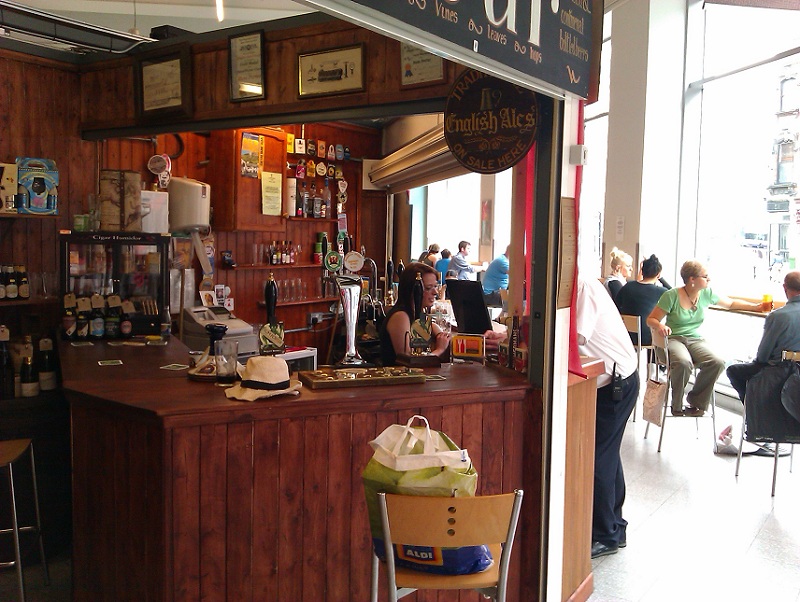
The Micro Bar is aptly named as it's little more than a market stall in the Food Market in the Arndale Centre, off High Street opposite the English Lounge / Bensons / Hogshead / Wheatsheaf.  Operated by Moston's Boggart Brewery, it offers house ales plus several guests, all on handpump from cooled casks beneath the bar top.  Despite the snow and associated freezing cold draughts blowing around the market, we ignored the dark beer winter-warming nonsense and enjoyed a decent pale ale.


Micro Bar, Arndale Food Market, High Street. (c) Beer Prole.

The bottled beer selection - UK, US, German, Belgian, and more - is arguably the best selection in the city centre and can be supped around the bar or taken away.  The Micro Bar was previously known as the Paradise Brewery Bar but didn't offer such a good selection and was guilty of serving from plastic pots.  Nowadays, it's a great place for gents to escape from the horrors of shopping, and you can even get fine cheese from the stall next door.  However, it's sadly limited by the closing times of the Arndale, which appear to be 8pm weekdays, 7pm Saturdays and 5pm Sundays.

Thursday, 16 February 2012

Pub Shaman of Prestwich


Even before the internet was dreamt of, there were places you could go to get a detailed history of the Pubs of Manchester. This wasn't the history of laptops, Google and Twitter half and quarter truths. It wasn't the history of writers and recorders of the past. This was old-school history - the history of bards and storytellers.

The price you paid to hear it was generally measured in pints, but what you got in return was a rich unfolding of tales of men (almost always men), women (almost always behind the bar), rivalries, breweries, places and above all changes. Change was always at the heart of these stories - an old world slipping away and being replaced by a shiny new one. 

And the shaman who presided over these stories, the men who had spent a lifetime recording and remembering and retelling these tales were red-faced, slightly dishevelled men who not only drank in pubs, but lived in them. My dad was one of those shaman. The clothes he wore were often bought from men who went from pub to pub with a van out back. The meat he ate often came from a similar source. He knew names of landlords, barmaids, owners. He knew which local hardmen to avoid and which to talk to. He knew which pubs had jukeboxes, had pool tables, had darts teams. He knew pubs. 

And for me as an adult, my increasingly rare drives around North Manchester are punctuated by the pubs that he drank in at different times of his life, as his aspirations and friends changed. It is impossible for me to drive past a pub without it prompting some involuntary recollection that I never knew was buried in my mind.  

Commercial. (c) Alexander P Kapp at geograph under Creative Commons.

For me pubs are more than places you drink in. When your dad is a pub shaman they are places you grow up in. Just as he grew old in them. I remember being about 13 and being taken to the Commercial on Bury Old Road opposite Heaton Park. I think it was a Tetley's house which was unusual in Manchester in those days. My dad knew the landlady.  In the days before early opening I remember her throwing him the keys to the pub's front door from the top window and telling him to let himself in and help himself to a pint. In those days he always bought me two drinks - a coke and a half of beer. One was for me to drink the other one was for show. Never really quite understood which way round that was meant to work. 

My parents had split by this stage. Not saying that with any sadness or self-pity - just a fact. Even by then my mum knew that pubs had won. In the days before mobile phones, once he had moved out, there were three numbers for him in our phone book:  

Dad home; 
Dad work; 
Dad - Commercial.  

The last one on the list was the number we'd call first, waking the taxi-card-covered plastic public phone by the side of the bar. Any of the bar staff would know which of his three young children were calling and would locate him. So before I was ever allowed into a pub I was considered pub family. 

Foresters. (c) Ingy the Wingy at flickr under Creative Commons.

As I got older the Commercial gave way to the Foresters on Bury New Road, a squat ugly pub that blended in to the buildings around it as if afraid that being noticed would bring in unwanted strangers. The Foresters landlord was Geoff, a man who turned so many blind eyes you wondered if it was pragmatism or apathy which drove him. I once remember a man who claimed to be a taxi driver trying to sell us a driving license and a birth certificate. There wasn't much that couldn’t be bought in the Foresters.

The Foresters was a grunge pub about 5 years before Nirvana ever took to any stage. In the early years of Care in the Community its customers often flitted between the local sprawling mental hospital ("largest in Europe") and the pub like the lost souls that they undoubtedly were. There wasn't much to the pub. A dirty vault with pool table and wall mounted jukebox. He always played three songs - Fats Domino's Blueberry Hill, Itchycoo Park by the Small Faces and Kenny Rogers' Ruby. This is 25 years ago. I can't remember much but I remember that. 

As well as the Care in the Community crowd, The Foresters had some distinguished drinkers too - although in their own way they were also lost souls. Mark E. Smith drank in there. So did Nico, who sang with the Velvet Underground and lived out her final years cycling around Prestwich on her push-bike, stick-thin and white like a ghost. The pub drew her to it as it drew my dad to it. The Foresters was a place where because no-one fit in, everyone fit in.

Looking back having an ex-member of the Velvet Underground drinking in the same nondescript pub as my dad was pretty remarkable. Not to the customers though. 90% of the people in the pub didn't know who she was. The same 90% who knew exactly who my dad was. That's what was great about those pubs at that time. They were democratic. By putting in the hours you could get yourself known and accepted.

Church Inn. (c) David Dixon at geograph under Creative Commons.

At some point in the later 1980s he flirted with gentrification - the Church Inn down Church Lane in Prestwich - now a food-serving pub, but even then a place which had some aspirations to being a bit of the countryside in town. Different place. Different friends. More middle-class. More professional. Which is what he was. But never what he wanted to be, or came to terms with being. Didn't last long at the Church. I think to him the people down there were playing at drinking. Slowly sipping a couple of pints on a Sunday afternoon, laughing and telling jokes with friends. Not the solitary pint in a smoke-filled vault pouring over a fixed odds coupon and going through a packed of Bensons. That's what he preferred.

In later years, once drink had him firmly in his grip, he settled. It was the Red Lion on Bury New Road. His feet weren't good. Had to be walkable. Had to be Holt's. That was his last local really. His elephants' graveyard. In 2004 he died. 

It was the drink that did for him of course. No shame in that. Something gets each of us in time. And no one was surprised it was drink. After all, he was a shaman of the pubs of North Manchester. Comes with the territory. He wasn't the only one. There were others. They knew each other, though often not by name. They acknowledged each other with silent nods. One by one they have disappeared. 

Drinking isn't like that any more. Drinking is now leisure, not work. The shamen are all dead or dying. Replaced by aggressive kids or bored couples. The rest of us just pour a glass of wine at home. And pubs get boarded up or sold or burnt out or demolished. They change interiors each year to try and remain interesting - but that has the exact opposite effect. Besides, the people who made them interesting are gone. And most of the stories have gone with them. 

Red Lion. (c) Ingy the Wingy at flickr under Creative Commons.

(c) @robwarm1 February 2012 

Wednesday, 15 February 2012

Rose & Crown, Denton Street


Rose & Crown, Denton Street, Hulme, 1912. (c) Bob Potts [1].

On the long-lost Denton Street in Hulme, which used to span between the upper ends of Chorlton Road and Upper Moss Lane, used to stand the Rose & Crown on the corner with Bentley Street.  It was first mentioned in 1866 was a Hardy's Brewery house [1] and is shown here as a Peter Walker's of Warrington house with licensee, Sarah Ann Pollitt, outside.  The photo is from 1912 but 25 years later the Rose & Crown closed for good in 1937 [12].  The former location of Denton Street and the Rose & Crown was roughly where Drayton Street is today.

Rose & Crown, Denton Street, Hulme, 1912. (c) Bob Potts [2].

1. The Old Pubs of Hulme Manchester (1) 1770-1930, Bob Potts (1983).
2. The Old Pubs of Hulme & Chorlton-on-Medlock, Bob Potts (1997).

Woodbine, Liverpool Street

Woodbine, Liverpool Street, Salford. (c) Salford Pubs of the 70s at flickr / Bob Potts [2].

The Woodline stood on the corner of Fleetwood Street and Liverpool Street from 1871 when it received a transferred beer licence from the Strugglers Rest on Toft Street, Ordsall Lane.  The Woodbine was rebuilt from a house and off-licence and passed into the hands of Groves & Whitnall, eventually closing in 1971 due to redevelopments.  The exact location of the old Woodbine was opposite where the lost (and sadly, as yet, picture-less) Brass Tally estate pub used to sit. 

2. Salford Pubs - Part Three: Including Cross Lane, Broad Street, Hanky Park, the Height, Brindleheath, Charlestown and Weaste, Neil Richardson (2003).

Monday, 13 February 2012

George, Pinder Street

George, Pinder Street, Hulme. (c) Visual Resources @ MMU at flickr [1].

The George is shown here, apparently in the mid-1960s, on the corner of Radnor Street and Pindor Street in Hulme.  All the houses around it have been pulled down for the first wave of slum clearance.  It closed in 1969 as a Tetley's house, having previously been a Charrington and Walker Cains house [2].  A small stretch of Radnor Street still exists today, at the back of ASDA's on Princess Parkway

1. www.flickr.com/photos/mmuvisualresources/5125354613/in/photostream.
2. The Old Pubs of Hulme and Chorlton-on-Medlock, Bob Potts (1997).

Bull Hotel, Briscoe Lane

Bull Hotel, Briscoe Lane, Miles Platting. (c) Google 2012. View Larger Map.

This ATS training centre on Briscoe Lane used to be the Bull Hotel, a free house which offered a few real ales when Alan Winfield popped in during the mid-'90s - Chesters Mild, Boddingtons and Websters (three almost dead brands these days).  The Bull Hotel is shown here in March 1995.  It still shows up on a few internet listings so the pub can't have closed that long ago.

Saturday, 11 February 2012

Grey Horse Inn, Wilmslow Road

Former location of Grey Horse Inn, Wilmslow Road, Rusholme. (c) Google 2012. View Larger Map.

The Grey Horse Inn is shown on Wilmslow Road, Rusholme, not far from Maine Road, in 1973 as a Greenall Whitley pub.  In this 1959 photo of the pub, its proximity to the Huntsman can be seen, so its former location was where this ugly block of shops is.  The 1959 shot also shows the Trocadero that used to stand next to the Huntsman and the 'Television Club' next to the Grey Horse.  This may have been the same Starlight Club - a popular pre-match haunt for City fans - which was once above the Grey Horse Inn (the 1973 photo shows a small sign which may read 'The Starlight Club').

Railway Hotel, Berigan Close


Railway Hotel, Berigan Close, Longsight. (c) Google 2012. View Larger Map.

As recently as September 2008, this Longsight estate pub was still signed as the Railway Hotel, despite being converted to a convenience store.  Move along Berigan Close and Charlies Mini Market might never have been a boozer.  The Railway was a Boddingtons house that was built to replace an older Railway, which is probably this one shown in 1965.  The newly built estate pub is shown 10 years later in 1975 and Alan Winfield photographed the Railway Hotel in 1993, when the layout of the council houses around here was quite different.


Railway Hotel, Berigan Close, Longsight. (c) Google 2012. View Larger Map.

Thursday, 9 February 2012

Cavalier, North Graves Drive

Cavalier, North Graves Drive, Cheetwood, 1995. (c) With permission of Alan Winfield.

The Cavalier is another lost estate pub of North Manchester which sat on the grimly-named North Graves Drives in Cheetwood.  During a visit in 1995 Alan Winfield reported this grim boozer had two of Manchester's lost classic ales, Chesters and Boddies, on offer [1]. The Cavalier was demolished when this part of Cheetham Hill was regenerated a decade or so ago, and the street was renamed to the similar but slightly less sinister Gravenmoor Drive.

1. www.pubsgalore.co.uk/pubs/76356.

Albert, Embden Street


Albert, Embden Street, Hulme, 1930s. (c) Bob Potts [1].

The Albert Hotel was first licensed in 1863 as an Empress Brewery house on Embden Street in Hulme [2].  It was later taken over by Peter Walker & Sons of Warrington who owned the Albert Inn until it closed in 1969. Under Walkers, the Albert advertised Falstaff Ales as well as the concerts it had done previously - "Select Concert Every Evening" [1].  Embden Street was lost in the first wave of the Hulme clearances and the approximate location of it and the old Albert is roughly where Holdgate Close is today.

Albert, Embden Street, Hulme, 1930s. (c) Bob Potts [2].

1. The Old Pubs of Hulme Manchester (1) 1770-1930, Bob Potts (1983).
2. The Old Pubs of Hulme & Chorlton-on-Medlock, Bob Potts (1997).

Tuesday, 7 February 2012

Vine Inn, Hough Lane

Vine Inn, Hough Lane, Lower Broughton, 1930. (c) Salford Pubs of the 70s at flickr.

Hough Lane used to run off Lower Broughton Road between the Poets Corner (and Peel Park Inn) and Royal Archer, and on the spot where the modern-day Antares Avenue is marked was the Vine Inn.   Hough Lane used to run through to Hough Farm in the River Irwell loop and where it met with River Street, the Vine Inn stood on the corner, first listed in 1869.  Unfortunately the pub's license was suspended in 1894 due to it being "frequented by loose persons" (nowt's changed in Lower Broughton).  The Vine was ran by former Broughton Rangers forward, William Winskill, and under him, Empress Brewery enlarged the pub by incorporating the neighbouring house into a bar parlour.  Walkers Brewery took over in the 1920s and Winskill was still running the place into the '40s.  The Vine finally closed in 1975 under the Lower Broughton clearances [2].

2. Salford Pubs - Part Two: Including Islington, Ordsall Lane and Ordsall, Oldfield Road, Regent Road and Broughton, Neil Richardson (2003).

Slip Inn, Butler Street

Slip Inn, Butler Street, Ancoats, 1912. (c) Neil Richardson [1].

Shown above exactly 100 years ago courtesy of the late Manchester pub historian, Neil Richardson, the Slip Inn stood on the corner of Canning Street and Butler Street in Ancoats.  It had been a grocer's shop before it was a Walkers beerhouse from 1865 to 1916 [1]. Canning Street was just off (Old) Mill Street and the end of Butler Street where the Slip Inn stood is still there today, near to where the Ancoats Youth Club stood until recently [2].

Ancoats Youth Centre, Butler Street, Ancoats. (c) historyme.

1. The Old Pubs of Ancoats, Neil Richardson (1987).
2. http://historyme.wordpress.com/ancoats-youth-club-butler-st-ancoats-manchester.

Lorimers Arms, Osborne Street


Former Lorimers Arms, Osborne Street, Collyhurst. (c) Google 2012. View Larger Map.

The Lorimers Arms is an other closed inner city estate pub on Osborne Street in Collyhurst, between Oldham Road and Rochdale Road.  It has been put to alternative use, this time as Lorimer House, the 'Fountain of Life Christian Centre', according to Google Maps.  It's a sad comment on the viability of inner city boozers, not to mention on the communities themselves, when minority religious headquarters are preferred to hubs of communities - pubs!  The Manchester pub crawler, Alan Winfield, photographed the Lorimers Arms in February 1994 as a Vaux house, as seen at Pubs Galore.

Former Lorimers Arms, Osborne Street, Collyhurst. (c) Google 2012. View Larger Map.

Monday, 6 February 2012

Birch Arms Hotel / Out of the Blue, Gorton Lane

Birch Arms Hotel, Gorton Lane, West Gorton. (c) Gene Hunt at flickr under Creative Commons.

When MCFC moved back to their East Manchester roots in 2003, the struggling Birch Arms Hotel in West Gorton had once last go as 'Out of the Blue' but it didn't last long despite the weekend footfall from nearby Ashbury's station.  I remember popping in here as the Birch Arms a few times on the way to the pictures at Belle Vue back in the day when it was Boddingtons on the bar.  Alan Winfield at Pubs Galore photographed the Birch in December 1994 and remembers the Bass tied house selling decent Bass bitter as well as Boddies (two of the most famous cask ale brands in the world, both reduced to unloved and rarely brewed novelties by the callous AB InBev).  Today the pub is in use as a nursery.

Birch Arms Hotel / Out of the Blue, Gorton Lane, West Gorton. (c) Google 2012. View Larger Map.

Duchess of Edinburgh, Liverpool Street

Duchess of Edinburgh, Liverpool Street, Salford, 1961. (c) Salford Pubs of the 70s / Neil Richardson [1].

The first beerhouse to open on the west end of Liverpool Street was the Duchess of Edinburgh on the corner of Siever Street (later Birley Street).  This was in around the 1860s and by 1874 it was owned by Charles Mottram of the Sun Brewery on Ford Lane.  Walker & Homfray took the Duchess before she passed to Wilsons then closed in about 1970 [1].  The former location of the old Duchess of Edinburgh is marked by the gates to Lark Hill Community Primary School.

1. Salford Pubs - Part Three: Including Cross Lane, Broad Street, Hanky Park, the Height, Brindleheath, Charlestown and Weaste, Neil Richardson (2003).

Duke of Edinburgh, Mill Street

Duke of Edinburgh, Mill Street, Beswick. (c) Manmates [1].

The Duke of Edinburgh is shown in 1963 as a Walker's pub and in 1971 as a Tetley's house on Mill Street, Beswick.  As late as 1989, this huge corner pub was still serving Tetley's on this once heavily-pubbed street [2].  The last boozer to go was the Bradford / Champagne Charlies / Guvnors.  The Duke of Edinburgh was at 366 Mill Street, which places it just where Mill Street now ends and has made way for Alan Turing Way.


Former location of Duke of Edinburgh, Mill Street. (c) Google 2012. View Larger Map.

1. http://homepage.ntlworld.com/alscot1/BradfordPhotos.htm.
2. Ale of Two Cities, Real Ale and Real Pubs in Manchester and Salford, CAMRA (1989).

Lord Rodney, Pollard Street

Lord Rodney, Pollard Street, Ancoats, 1950s. (c) Neil Richardson [1].

The Admiral Lord Rodney opened in the 1820s, straddling Howe Street and Rodney Street on Pollard Street, fronting a row of back-to-back dwellings [2].  Later, the Pollard Street Brewery replaced these tiny houses and Rodney Place to the north and east.  In 1869, John Taylor was licensee of the Lord Rodney and by the 1920s he'd built up John Taylor & Co Ltd into an estate of 18 pubs and beerhouses and 24 off-licences around Manchester.  He sold up to Walker & Homfray in 1929 and the pub passed to Wilsons before it closed in 1972 [1].

Admiral Lord Rodney, Pollard Street, Ancoats, 1849. (c) Alan Godfrey Maps [2].

In the 1930s, Mick Burke used to sell his fruit & veg outside the Lord Rodney.  "Most of my customers came from the [back-to-back] dwellings and Stevenson's box works... I would get £30 a week from the Lord Rodney pitch.  The landlady of the Rodney was a widow, a nice woman.  I would sometimes pull pints for her and the women of Stevenson's would joke about me being the landlord [1]."

1. The Old Pubs of Ancoats, Neil Richardson (1987).
2. Ancoats 1849, Alan Godfrey Maps (2011).

Sunday, 5 February 2012

Old Veteran / Ugly Duckling, Duxbury Street


Old Veteran, Duxbury Street, Salford. (c) Salford Pubs of the 70s at flickr [1].

The Old Veteran Tavern opened as a beerhouse in 1880 in a converted house on the corner of Stowell Street and Duxbury Street just off Eccles New Road.  It was run by a former Salford bobby, Henry Hargreaves, with a refreshment room, vault to the left of the front door and a newsroom.  Groves & Whitnall took over in 1891 and by the 1970s the Old Veteran was under the ownership of Greenall Whitley [2].  


Former Old Veteran, My Street, Weaste. (c) Google 2012. View Larger Map.

When the pub was included in the Bridson Street compulsory purchase scheme (presumably for the M602), a CAMRA campaign helped the brewery save it from demolition.  The pub closed in 1984 but when it reopened in 1986, it had incorporated the two adjoining houses, and the Old Veteran's grand re-opening ceremony was officiated by Manchester City manager, Billy McNeill [2].  

Ugly Duckling, My Street, Weaste. (c) beerintheevening.

The Busy Pubs Ltd pub company took over in 1997 and renamed it the Ugly Duckling but it finally closed for good in the 2000s [2].  The Old Veteran soldiers on these days as flats on the oddly renamed My Street, sandwiched in between the motorway, railway and tram lines.


Old Veteran, Duxbury Street, Weaste. (c) Salford Pubs of the 70s at flickr.

2. Salford Pubs - Part Three: Including Cross Lane, Broad Street, Hanky Park, the Height, Brindleheath, Charlestown and Weaste, Neil Richardson (2003).

Crescent / Old Brewery, Bell Crescent

Old Brewery, Bell Crescent, Beswick. (c) Old Maps.

The Crescent was a Chesters estate pub, previously known as the Old Brewery on Bell Crescent, just off Ashton Old Road in Beswick.  As the Old Brewery, it had a dodgy reputation and actually predated the final razing of the Fort Beswick flats (sister to the Fort Ardwick abomination).  The flats can be seen behind the council houses in this 1983 photo taken from Bell Crescent.  


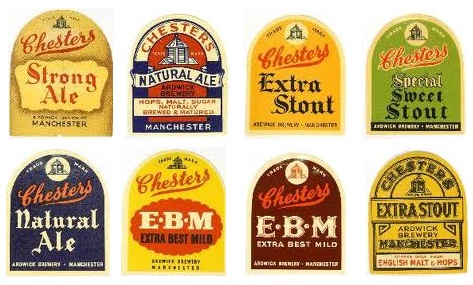
Chesters beers. (c) Tavern Trove.

In the 1989 CAMRA Pub Guide, the Crescent received a glowing review, however, with enthusiastic licensees giving an 'improving area' (their words) a much-improved, spacious, modern pub.  The vault boasted a timber ceiling and pubs games, the large lounge was furnished in pastel shades, while the bar proudly boasted a "Real Ale" plaque, which clearly pleased the pub reviewers, offering Chesters Bitter and Mild [1].  The Crescent sounds like a belting estate pub. 

1. Ale of Two Cities: Real Ale and Real Pubs in Manchester and Salford, CAMRA (1989).

Friday, 3 February 2012

White Hart, Collyhurst Street


Former location of White Hart, Oldham Road, Miles Platting. (c) Google 2012. View Larger Map.

The White Hart was a Wilsons house on the corner of Oldham Road and Collyhurst Street and was still open in the late 1980s, serving real ale as documented in the CAMRA guide of 1989 [1].  This Miles Platting pub was run at some point by Freddy Watson, who also had the Regent estate pub in Salford at one time [2].  As to be expected, nothing has been built in place of the White Hart since it was pulled down at some point in the 1990s.  Thankfully the Manchester Archives have several of photos of the pub - here in 1961 and 1976.  Also in 1976, the White Hart is a familiar sight with three drinkers standing around the door, but they're sunbathing rather than smoking, and in 1981, the White Hart was captured in colour.

1. Ale of Two Cities - Real Ale and Real Pubs in Manchester and Salford, CAMRA (1989).

Sherwood Inn, Tib Street

Although sadly there are no pictures of the Sherwood Inn on Tib Street in what is now the Northern Quarter, this pub has passed into Manchester's riotous history thanks to the archiving of the following snappily-titled book by the Internet Archive, The trial of Feargus O'Connor, Esq., barrister-at-law, and fifty-eight others at Lancaster: on a charge of sedition, conspiracy, tumult, and riot [1].  As they go on to explain:

"This is a digital copy of a book that was preserved for generations on library shelves before it was carefully scanned by Google as part of a project to make the world's books discoverable online.  Public domain books are our gateways to the past, representing a wealth of history, culture and knowledge that's often difficult to discover... from the publisher to a library and finally to you [1]."

Yeomanry attacking demonstrators at the Peterloo Massacre, St Peters Square, 1819. (c) Cotton Times.

It appears that in August 1842, a gathering of the trades was held at the Sherwood Inn, attracting almost 150, led to a larger demonstration at the Carpenter's Hall nearby, and this in turn led to the arrest of Feargus O'Connor and others:

- "In the month of August last, were you a reporter for the Manchester Guardian?"
- "I was, sir." 
- "On the 15th of August was there a meeting of the trades' delegates in Manchester? 
- "There was, sir." 
- "Where was it held?" 
- "At the Sherwood Inn, Tib Street."

"I go to the Sherwood Inn (Tib Street) in the most public part of Manchester; a crowd gathers round: I request them to disperse; and I say, 'Look out for a place where we can meet without being interrupted'" [1].

As the crowd moved on to the Carpenters Hall, the gathering got more rowdy and the police were involved, leading to the arrests and the eventual publication of the trial.  Read more about this, and more of Manchester's proud radical past, at Manchester's Radical History: Exploring Greater Manchester's Grassroots History [2].

Thursday, 2 February 2012

Union, Union Street

Union, Union Street, Chorlton-on-Medlock, 1965. (c) Bob Potts [1].

The Union closed as a Wilsons house in 1967, two years after it was photographed as shown above.  It sat on the corner of Renshaw Street and Union Street and had previously been a Renshaw & Cardwell house [1].  The location of the Union is roughly where Eyre Street is today, which in the past used to be Renshaw Street all the way up Epping Street to Stretford Road.

1. The Old Pubs of Hulme and Chortlon-on-Medlock, Bob Potts (1997).

Cumberland House, Ellesmere Street

Cumberland House, Ellesmere Street, Salford. (c) Salford Pubs of the 70s at flickr.

In the days when Ellesmere Street used to run all the way from Ordsall Park up to Regent Road, the Cumberland House stood on the south-west corner of Martha Street, just south off Regent Road.  Opening in 1868, the beerhouse's licensee by 1905, Walter Harreston, was fined 2/6d for giving "long pull".  This was the unthinkable practice of over-serving your customers in order to keep the pub busy, and the Cumberland was so known locally as 'The Long Pull'.  Police sent in lad with a jug for a pint and he was given 1 and three-quarter pints, and in his defence the landlord claimed "the man at the Egerton is doing it worse than me".  By now Cornbrook Brewery had the Cumberland House but it eventually closed in 1974 [1].

2. Salford Pubs - Part Two: Including Islington, Ordsall Lane and Ordsall, Oldfield Road, Regent Road and Broughton, Neil Richardson (2003).

Monday, 30 January 2012

Drop Forge, Greenside Street

Drop Forge, Greenside Street, Openshaw. (c) D.N. at ManMates Facebook [1].

"When we first moved up to Openshaw village there was some nice shops.  Where they have built the family housing now there used to be a pub called Drop Forge, there was a newsagents, there was a chippy, there was a vegetable shop and there was a paper shop [2]."  The Drop Forge stood on Greenside Street, towards the top end near Clayton Lane where the new houses are.  The 1984 snippet from the London Gazette, below, names Michael and Jennifer McGuigan as publicans at the Drop Forge.   In its last days in the late '80s, early '90s, it was listed as selling Websters Bitter [3].

Drop Forge, Greenside Street, Openshaw. (c) London Gazette.

1. www.facebook.com/ManMates.co.uk.
3. Ale of Two Cities, Real Ale and Real Pubs in Manchester and Salford, CAMRA (1989).

Alexandra, Mill Street

Alexandra, Mill Street, Bradford. (c) DN at Manmates Facebook [1].

The Alexandra sat on the corner of Stuart Street and Mill Street in Bradford, just off where Alan Turing Way passes these days.  The pub is shown twice at the archives in 1963, firstly as a Wilsons house, then advertising the much-maligned Watney's.


Alexandra, Mill Street. (c) Alan Gall [2].

The Alexandra was still open in 1989, listed as selling Tetley's bitter and mild [3], but almost a hundred years earlier, it was in the news for being the meeting place where the Bradford and Clayton Athletic Ground Company was wound up, as shown above.


Alexandra, Mill Street, Bradford. (c) London Gazette. 

1. www.facebook.com.
2. Manchester  Breweries of times gone by, Alan Gall (year unknown).
3. Ale of Two Cities, Real Ale and Real Pubs in Manchester and Salford, CAMRA (1989).