Pubs of Manchester

All pubs within the city centre and beyond.
A history of Manchester's hundreds of lost pubs.

Sunday, 24 January 2010

Branagans, Royal Exhange Arcade


Branagans, Royal Exchange Arcade. (c) Neil T at flickr.

Not to be confused with the chain disco pub on Peter Street, Branagans in its time was one of the most popular cellar bars in Manchester.  A small entrance in the walk through at the Royal Exchange led to stairs which took you down into a large pub space below.  The most imposing feature of the pub was its huge, long bar, which meant you could always stand at it whilst trying to get served, although at busy times, it also meant you could easily get overlooked.

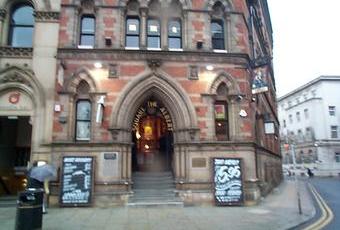
Former Branagans, Royal Exchange Arcade, 2010. (c) Pubs of Manchester.

This pub was mainly popular with the younger crowd, and also football fans early on a Saturday night.  Later on the back room would also open where a disco was on every Friday and Saturday night and attracted plenty of the females of the species.  In the late 1980s Branagans was something of a real ale place, with Tetley, Theaskstons Best, Old Peculiar, Websters Bitter and Choice, and Wilsons [1].

Royal Exchange Arcade. (c) unknown at flickr.

Branagans shut down in the 1990s and there is now little evidence that it ever existed (would have been just on the right as you entered from Corporation Street).  However, I would expect that most of the fixtures and fittings will still be intact down there for when someone wishes to give it a go again.

1. Ale of Two Cities, CAMRA (1989).

Saturday, 23 January 2010

Blue Boar Hotel, Blue Boar Court

Blue Boar Hotel, Blue Boar Court. (c) F. Greenwood, courtesy of David Pryer [1].

The Blue Boar Hotel once stood where the western side Arndale Centre now sits, off Corporation Street.  As seen in this 1895 photo from the archives, looking through the passage way out onto Market Place, these courts off Market Street and Market Place were narrow and crammed full of shops, businesses and licenced premises.  The Blue Boar suffered WWII damage and was fully demolished for the Arndale Centre - a lost part of the historic city centre which more resembled York than the Manchester we know today.

1. F. Greenwood in The Story of the Old Wellington Inn, Cornbrook Brewery, 1950.

Lower Turk's Head, Shudehill

Lower Turk's Head, Shudehill, 2008. (c) deltrems at flickr.

The Lower Turk's Head has been threatening to reopen (or get turned into flats) for years; a licenced premises application was submitted in October 2008 but nothing has come of that yet.  Judging from the popularity of the nearby Hare & Hounds, this place would be a welcome addition to the fringe of the Northern Quarter, and another reason - if one were needed - to stay away from the Printworks.

Lower Turks Head, Shudehill. (c) NAH1952 at flickr.

In the 1800s the Lower Turk's Head was where stagecoaches to Ashton-Under-Lyne and Royton went from [1].  The ornate tiling has been carefully maintained; the MB above the door stands for Manchester Brewery Company, though in the 1970s it was a Wilsons house, and had outdoor seating in 1990.


Lower Turk's Head, Shudehill, 2008. (c) Bluemooner93 at flickr.

Reader 'Comfy Gill' remembers the Lower Turk's Head: "This pub has a special place in the Great Pub Crawl of life, the place of my first glass of beer.  I nearly said 'pint' but it was a gill at the cost of 2p.  This was 1956.  Wilsons was one of my favourites, but then lots of things tasted better in those days."

Lower Turk's Head, Shudehill. (c) Manchester Pub Surveys [2].

Meanwhile the rumours continute that the Lower Turk's Head may one day reopen.  Wouldn't this place have been the perfect location for the new Marble Brewery city centre pub (recently opened in the functionally and rather industrial 57 Thomas Street in the old Love Saves The Day café)?

Lower Turk's Head, Shudehill, 2008. (c) hola_miola at flickr.

Rat & Parrot, Old Bank Street


Rat & Parrot, Old Bank Street. (c) Scottyweb.

The Rat & Parrot (not to be confused with Paddy's Rat & Carrot, the old Seftons) was a dreadful chain pub off St Ann's Square, later known as the Colour Bar, Yatra Lounge, Judas Lounge and Sensations Lounge.  Expensive drinks, poor service, poor ale, so good riddance.  This place has recently reopened as Sandinista.

Rothwells, Spring Gardens


Rothwells, Spring Gardens. (c) Scottyweb.

Rothwells opened approximately the same time as its close neighbour, Athenaeum, it set out to attract the bottle-drinking, trendy crowd.  It was housed in the 120-year old, Grade-II listed Lancashire & Yorkshire Bank building.  It was a big open pub with virtually nowhere to sit and standing room only, with music at silly levels at weekend.  For a while it was packed to the rafters, however as is usually the case, it soon fell out of favour and eventually closed.  It turned into the restaurant Establishment which has also now closed.


Rothwells, Spring Gardens. (c) Panoramio.

Square Albert / Consorts, Albert Square


Square Albert, Albert Square. (c) beerintheevening.

Situated proudly on the corner of Albert Square, overlooking the Square itself and Manchester Town Hall, this once proud pub has now shut down.  At one time, when this end of town was much more popular, the Square Albert was a thriving pub and even had its own nightclub below (Consorts).  Eventually though, as more and more people headed towards the Deansgate and Printworks end of town, it became too much and shut down approximately six years ago.  Entering upwards via the stairs from the front (no disabled access), the pub opened out into a huge room, not dissimilar from the interior of The Bank pub these days.  Usually a good array of beers and a slightly older crowd made the Square Albert a decent pub to go to.  Also situated near the night spots of Devilles and Cellar Vie, many frequented here before moving on to other venues.

Consorts, its sister pub/club could be accessed internally via the back stairways to the toilets or by separate door outside.  In effect, this was one of the fore runners of the late night bar rather than a nightclub though.  The last of these three 1981 photos shows the side entrance to Consorts.  At the time of writing, planning permission has been granted for a new Italian restaurant, called 'Bla Bla', to open in the building.  Update: as of 2012, the Albert Square Chop House has opened in this fine building.

Cast / Stage Door / Playground, Oxford Street


Cast, Oxford Street. (c) carling/Local Data Company.

Cast, previously the Stage Door and in the mid '70s, The Playground, was on Oxford Street next to the Palace Theatre, used to open from 6pm, so just about qualifies for inclusion.  It was popular with theatre goers but closed a couple of years ago.  As The Playground it had topless dancers on at dinner time, and in the evenings, said dancer would be relegated to a platform in the Edwardian Bar in the basement.   Worthington E, Toby Mild, Carling, Guinness and a DJ playing thumping disco music were the other dubious attractions in here [1].

Cast, Oxford Street. (c) Google 2010. View Larger Map.

1. The Manchester Pub Guide, Manchester & Salford City Centres (1975).

Sports Café, Quay Street


Sports Cafe, Quay Street. (c) gmgrd.

One of the Sports Café chain that tried to tie general sports in with American style pool tables with live telvised football.  What it failed to grasp was that many local pubs had this without the necessity to pay high prices, both to play and to drink and they didn't have enough of an angle to attract the hoardes required to succeed.  Closed down when the whole chain went into administration.  It clearly wasn't a profitable venture as the Manchester branch wasn't included in the buy-out when part of the company was sold off. 

Courtney's, North Parade

Courtney's, North Parade, 1995. (c) Alan Winfield with permission.

In the corner of Parsonage Gardens, actually on North Parade and surrounded by offices, Courtneys was a very popular pub straight from work and there were many a works do held here.  Entry via a set of steps in the garden took you into a type of cellar bar on various levels when you got down there.  This could lead to some disorientation later in the evening when refreshed due to the one way in, one way out, and when the place was packed as exits easily seemed to become obscured.


Courtney's, North Parade, Parsonage Gardens. (c) Pub Explorer.

Officially titled Courtney & Co Vintners for a time (see top), the bar was situated right in the centre of the pub with rooms and seating areas leading off at all angles.  A very popular pub in its day, Courtney's probably more than most suffered by the increase in popularity of Deansgate and surrounding areas which it backed onto, as the pubs and bars that opened there were very much after the same catchment crowd.

Courntneys, Parsonage Gardens. (c) carling.

Pig & Porcupine, Deansgate

Pig & Porcupine, Deansgate. (c) Darkstar at Closed Pubs.

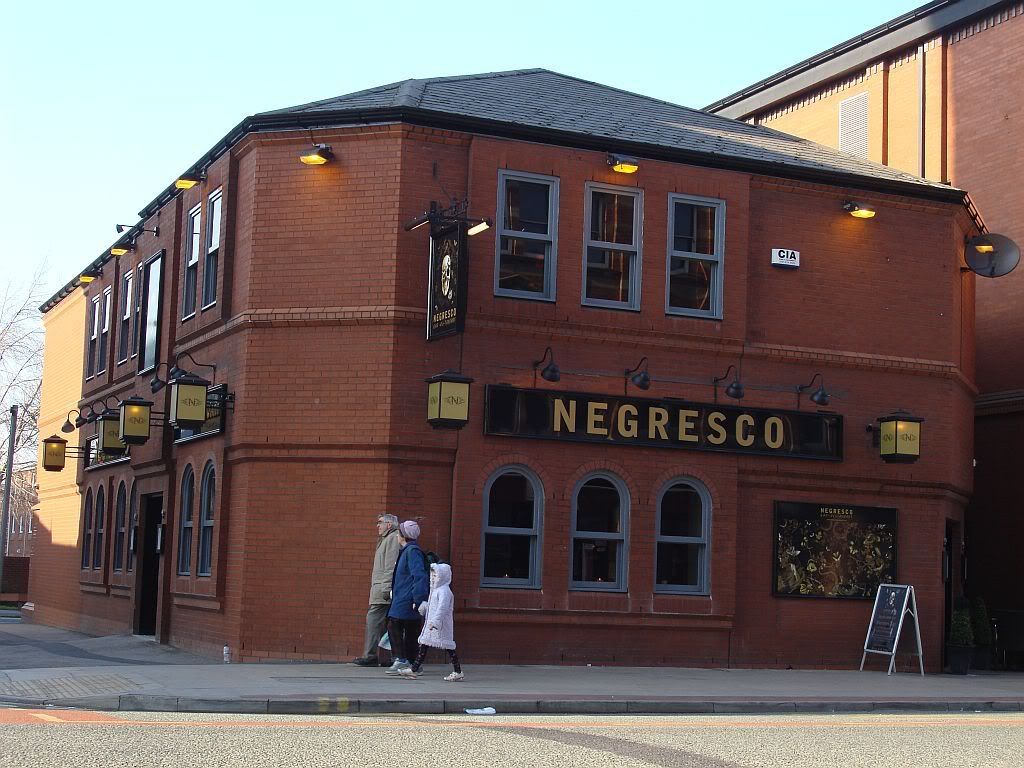
The Pig & Porcupine at the bottom of Deansgate was a modern Boddington's and then Holt's house, and a popular match day haunt for United fans before their journey down Chester Road to Old Trafford.  It was also popular with a few Corrie stars from the nearby Granada Studios and was so close to the studios that Granada used the Pig & Porcupine as Liz McDonald's pub, The Queens.  It closed around 2005 before reopening as an Italian Restaurant, Negresco.

Negresco, Deansgate, 2008. (c) markydeedrop at skyscrapercity.

Negresco then closed in late 2008 and has recently been replaced Lal Quila, of Rusholme's Curry Mile fame, as they expand into the city centre.  Although advertised as a bar and restaurant, this is still a curry house so remains off our radar for now.

Lal Qila, Deansgate. (c) Adam B. at flickr.

Cyprus Tavern, Princess Street

Cyprus Tavern, Princess Street (owner Takis Kitromilides). (c) Yiannis Kitromilides.

The Cyprus Tavern is a famous old Manchester institution and was opened in 1967 by Takis Kitromilides, brother of the locally famous Denos Kitromilides.  For nearly 25 years it was a family-run restaurant, pub and later, nightclub.  Parts of the interior reflected the background of the Kitromilides' with some Greek-Cypriot decor and the white arches giving the place a 'taverna' look.  Takis's son, Yiannis, took over as owner-manager in 1989 and has kindly supplied the photos shown here, along with much of the history.

Cyprus Tavern, Princess Street. (c) Yiannis Kitromilides.

In the '70s and '80s it was the late-night drinking home of many of the local late-teens and twenty-somethings particularly at weekends, and patronised by students during the week.  Indeed it was one of the first nightclubs to be student-friendly in the late '70s.  To the uninitiated it was considered a rather daunting place to go, particularly during the football season, when the blue or red halves of Manchester would frequent it every other weekend, and fights would often ensue, particularly later in the evening.  It was notable as focal point for one of City's firms, the 'Young Guvnors'.


Cyprus Tavern, Princess Street. (c) Yiannis Kitromilides.

Cyprus Tavern, Princess Street. (c) Yiannis Kitromilides.

The Cyprus Tavern would also host various music evenings, both by DJ (playing mainly indie music) and by live bands.  Local legends such as The Distractions, The Passage, Crispy Ambulance and 808 State, played at the Cyprus Tavern in the '70s and '80s.

The Distractions (Mike Finney vocals, Alex Sidebottom on drums) at Cyprus Tavern, 1981. (c) Mark David Cooper.

The famous nightclub Legends (now Fifth Avenue) was over the road in the '80s.  As former DJ at the Cyprus Tavern and Bar Manager at Legends, Darren Bradley recounts, trouble would sometimes brew in both venues and police riot vans would park up around the corner, ready for any trouble.


Cyprus Tavern, Princess Street. (c) Yiannis Kitromilides.

Cyprus Tavern, Princess Street. (c) Yiannis Kitromilides.

It's a common misconception that the Cyprus was shut due to licencing problems associated with football-related violence, and although the venue was subject to much unwanted police surveillance, this was not actually the case.  Takis and Yiannis, understandably fed up of the police interest, simply decided to close-up in 1991 as they felt the place had run its course.


Poster in Cyprus Tavern. (c) Cyprus's Facebook group.

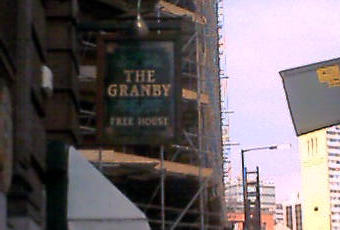
It re-opened as The Granby in the early '90s and reinvented itself slightly, as a mainly student venue, which did succeed for a reasonable time, attracting local celebrities such as Steve 'Alan Partridge' Coogan and Mark E Smith of The Fall.  It was the first late-night bar of its time, and can be considered the forerunner of many of Manchester's thriving bars today.  Like the Cyprus and Legends before it, The Granby's closeness to Fifth Avenue meant it would pick up stragglers from there that either didn't want to or couldn't get in.  The Granby was a still pretty popular with football lads; we popped in a fair few times en route to or on the way back from Moss Side in the '90s.


The Granby, Princess Street. (c) Beerintheevening.

The Cyprus still lives on as the San Siro restaurant, and the Greek restaurant, Bouzouki By Night, two doors down Princess Street was originally owned by Takis Kirtomilides.  Thanks once again to Yiannis Kitromilides who got in touch to help us add words and pictures to the history of this great Mancunian venue.

Cyprus Tavern, Takis and Yiannis Kitromilides and chef. (c) Yiannis Kitromilides.

Facebook group - The Cyprus Tavern: "We Saw The Whole Of The Moon": www.facebook.com/group.php?v=wall&gid=6198884723.

Pen & Wig / Wellington / Railway Inn, New Bailey Street


Pen & Wig, New Bailey Street, 1990. (c) deltrems at flickr.

On the Salford edge of our boundary, and just opposite the Mark Addy pub, was the Pen & Wig on the corner of New Bailey Street and Brown Cross Street.  A small two-roomed pub with central bar area, it was a regular haunt for people coming out of the adjacent court rooms following charges.  More often than not, they would try the Mark Addy first but would be refused entrance and would therefore opt for the more downmarket alternative. The pub was previously known as the Wellington, seen below as a Wilsons house in the 1960s or '70s.  Random fact about the Wellington: it was the first pub in Salford to be granted a TV licence in 1952 [1].  The Pen & Wig was so renamed, when the courts were built, in 1978.  A Websters pub, it survived until 1998 and it was demolished in 2001, first for a car park and now for an office block and Spar shop on the same site.


Wellington, New Bailey Street. (c) Salford forum.

In 1863 there was a butcher's shop on this site and this became a beerhouse ran by John T Bailey, named as the Railway Inn in the 1870s.  A few years later it became the Wellington Inn and in 1904 it was taken over by Wilsons Brewery after a few years as a Britannia Brewery house.  Wilsons made many changes to the Wellington over the years, cladding the ground floor in the traditional cream tiles and adding the "Sign of Quality" draughtboard where the corner door used to be [2].

Wellington, New Bailey Street, 1965. (c) Neil Richardson [2].

2. Salford Pubs. Part One: The Old Town, including Chapel Street, Greengate and the Adelphi, Neil Richardson (2003).

Beer Trading Co., Mosley Street

Former Beer Trading Co., The Pure, Mosley Street. (c) carling/Local Data Company.

A bar set amongst the financial areas of Manchester and based upon the London Stock Exchange with banks of televisions displaying prices and movements for all of the different beers on sale.  Prices throughout the night would rise or fall depending on the number of bottles sold.  The more popular beers would of course get dearer as the night went on, the less popular cheaper.  At some point the cheap bottles became so cheap people would start buying and the expensive bottles would reach such a price that again, people would stop buying them.  It made for interesting nights.  There would also be various "Price Crashes" to mimic the Stock Exchange, when all prices would plunge.  This didn't happen very often when busy!  The Beer Trading Co. closed in the 1990s and appears to have been The Pure nightclub for a time, as both venues are listed as No.55 Mosley Street.

Lord Howe's Fleet, Bengal Street

Lord Howe's Fleet, Bengal Street, Ancoats. (c) Neil Richardson [1].

The Lord Howe's Fleet stood adjacent to the still standing Shamrock on Bengal Street, opposite the 1894 Victoria Square housing development. Known in the 1820s as the Wellington, the Fleet was demolished in the 1950s, as pictured above, leaving an unused plot of land, as seen in this photo.  It was a three-story pub that loomed over the Shamrock slightly.  In the early days it was used as a theatre and comedy venue, with characters such as Dicky Baines, author of the 1800s ditty 'Manchester's Improving Daily', appearing there [2].


'Manchester's Improving Daily'. (c) Sing London.
.
Mick Burke "used to drink in the Shamrock and the Fleet with the Irishmen. The Catholics and the Orangemen used to mix in together. When they didn't want you to know their business they would speak Gaelic [1]."
.
1. The Old Pubs of Ancoats, Neil Richardson (1987).
2. Papers of the Manchester Literary Club (1878).

Friday, 22 January 2010

Nelson, Oldham Road

Nelson, Oldham Road, Ancoats, 1970. (c) historyme [1].

The Nelson, in its various guises, stood on the corner of Oldham Road and Radium/German Street (see the Cross Keys).  It started out as the Nelson of the Nile in 1815, the Death of Nelson (1830/40s), then the Lord Nelson, the Nelson Vaults, and finally the Nelson until its closure in 1985 [2].  It was owned by McKenna's Brewery in the late 19th century and here's a 1959 photo of the Nelson Vaults as a Wilsons house.  In recent times the old pub has been scandalously hidden behind ugly blackened boards.


Nelson, Oldham Road. (c) Google 2010. View Larger Map.

From The Old Pubs of Ancoats: "the "Death of Nelson" was a popular patriotic ballad and the singing of such a song [was blamed] as the cause of a murder in the Nelson in 1830.  A dresser called Marshall, who worked in a Jersey Street cotton mill, was singing to a full taproom when three customers took offence at the anti-Catholic sentiments.  Marshall was knocked down and a man called Trayner jumped on him and killed him [2]". 

Nelson, Oldham Road. (c) Neil Richardson [2].

The Nelson was just about still standing but in a terrible state until recently, however 2011 has seen it pulled down, exposing the previously hidden tiling within.


Nelson, Oldham Road, 2011. (c) historyme [1].

1. http://historyme.wordpress.com/2011/08/22/the-nelson.
2. The Old Pubs of Ancoats, Neil Richardson (1987).

North Western Hotel, Halliwell Street

North Western Hotel, Halliwell Street. (c) Manchester Local Image Collection. Click here to view full image.

Victoria-bound trams now pass down Halliwell Street. These 1966 and 1976 photos show the Samuel Smiths owned North Western Hotel on the corner of Halliwell Street and Corporation Street.  This spot has long since been replaced by a rather nondescript block of office and shops.


Former location of North Western Hotel, Halliwell Street. (c) Google 2010. View Larger Map.

Castle Inn, Hunts Bank

Castle Inn, Hunts Bank. (c) manchester.gov.uk [1].

The Castle Inn (Or Caftle Inn, f denoting the historic long or medial s, as on the map) stood on Hunts Bank as it rose from the River Irwell before Victoria Station was built in 1838 after the purchase of land including Hunts Bank, by the Manchester & Leeds Railway. A local bard, Charles Kenworthy, described the change taking place in the area in 1838 in verse:

"The 'Castle', that long braved the flood,
Where oft was brewed stout ale and good
A College Inn is seen
Where frowned the ancient dungeon wall
Rose modern buildings, fair and tall
And stables Paletine" [2]

The Castle Inn was presumably named after Manchester Castle (this itself may have been no grander than an wooden palisade on the highest point of the embankbank). This drawing from 1780 shows that dungeon that stood on Hunts Bank, with the old cathedral in the background. Is that the Castle Inn on the left where the snappily dressed thirsty fellows are headed? As the above verse suggests, the Castle was later named the College Inn, after Chetham's School, which has survived in the area for over 550 years.

1. www.publicaccess.manchester.gov.uk/...pdf.
2. Memorials of Manchester Streets, Richard Wright Proctor (1874).

New Castle & Falcon Club, Dantzic Street

New Castle & Falcon Club, Dantzic Street, 1992. (c) deltrems at flickr.

This club presumably opened in response to the impending or actual closure of the Castle & Falcon round the corner on Bradshaw Street . From the below picture it looks like the New Castle & Falcon was on the lower part of Dantzic Street, off Shude Hill, just north of the Printworks as indicated.  
.

Dantzic Street, Shudehill. (c) Google 2010. View Larger Map.

Yates's / Blob Shop / Brooks Bar / Market Trader, High Street

Yates's, High Street, 1990. (c) deltrems at flickr.

One of the more popular Yates's in town, this was a tardis of a pub.  A tiny entrance at the front betrayed a large cavernous room at the back.  One of the first pubs to introduce a queuing system at the bar due to how busy it got, this really worked and was respected by punters and bar staff alike.  Also had one of the steepest stairways to a toilet in Manchester and many a drunken customer would come crashing down at various times in the evening.  The pub itself was famous for its Blobs or "All Ins" if you were posh, consisting of Yates Original Liqueur wine, sugar and hot water.  A drink that seemed to speed up drunkenness to a young drinker like myself at the time.

Situated next to Champers wine bar (now Ruby Lounge), it was popular with people wanting a drink before the loud music in the venue next door and this in a time when this end of town was still very busy with revellers.  After the Blob Shop it became Brooks Bar when it really went down hill, probably on account of its all day 99p pints, which tended to attract a certain calibre of punter. Then briefly the Market Trader, Dr Livvy's, a down-market bar and grill, and nowadays it is Melodies, a karoake bar (no thanks).


Brooks Bar and Dr Livvy's, High Street. (c) Beer in the Evening and Manchester Bars .