Pubs of Manchester

All pubs within the city centre and beyond.
A history of Manchester's hundreds of lost pubs.

Monday, 8 February 2010

020. City Road Inn, Albion Street


City Road Inn, Albion Street, 2010. (c) Pubs of Manchester.

Maybe it's just us, or maybe the state we arrived in, but following a quick couple in the Britons Protection, it's round the corner to the City Road Inn. Another pub that has been here for donkeys, with a strange but loyal clientele. Quite busy as we arrived, I popped in, established there was no real ale, then stood waiting for two Guinnesses, but alas to no avail. Despite the bar not appearing that busy, there was no sign of any service, so reluctantly left after about five minutes. Like the Peveril, we will try again at a later time!

The pub itself looks grand, seen here in the '60s, but is just one big room and one pool room. It's usually quite quiet, although is clearly benefitting from the popularity of the Deansgate Locks complex opposite. Traditionally a haunt for football fan on a Saturday (it's not that far from Old Trafford), the rest of the times it seems to be a mixed crowd. In the '80s through to the mid-'90s it was often the venue for a few pre-gig pints before clubbers would head over the road to the famous Hacienda. Could do with some real beer, maybe it was just off when we were there, but couldn't see a pump. The brilliant photo below shows the pub in the shadow of the Hilton Tower (the 23rd floor of which contains an exclusive bar which we might well include if only for the excellent views of town that it will offer).


City Road Inn, Albion Street. (c) markydeedrop at skyscrapercity.

Edit: We finally managed to revisit the other night and were this time met with a welcoming barmaid, though the pub itself was virtually empty. There was only the one real ale on (Black Sheep), however there was also Cumberland Ale at other times but was currently off. Worth a visit to this little pub (its outward size which belies its cozy interior), which, I suspect, could do much better with its fantastic location near to some much more popular pubs - Britons Protection, Knott, Deansgate, Cask - and not so great bars - Atlas and all of Deansgate Locks.
.
A bit of history: the City Road Inn is listed in the Slater's Directory of the mid 1800s, with James Hadfield running the pub.  Interestingly, this extract from the directory is on the reverse of the 1849 map and that map shows the Hawthorn Tavern still standing at this very corner on what used to be Smith Street [1].  The City Road Inn must have been built not long after that.

1. Manchester (Oxford Street & Gaythorn) 1849, Alan Godfrey Maps (2010).

019. Peveril of the Peak, Great Bridgewater Street


Peveril of the Peak, Great Bridgewater Street, 2010. (c) Pubs of Manchester.

Lovely old photogenic pub bedecked in the green Wilsons livery tile that was prevalent in its day, and usually the purveyor of fine beers and ales. The Pev is mentioned in Ancoats Lad, where Mick Burke describes how the theatricals from the nearby Hippodrome (then later the Gaumont) Theatre would slip out of the stage still in their powder and paint right into the Pev for a quick drink [1].

Sadly on our last visit, despite standing at a virtually empty bar for nigh on five minutes, the bar staff couldn't care or couldn't be arsed to serve us so we left without sampling. It will be revisited later in the year when we will give them another chance to rectify this unfortunate problem and will update here accordingly. Archive photos from 1964, 1970, 1972 and 1994.
.
Update: a second attempt to have a pint in the Pev was met with a sadly locked front door. Worrying that this flagship Manchester boozer was not open on a Saturday afternoon! The upside of it being shut was that we had an excuse to nip in Rain Bar again for a pint of Coronation Street and Brewers Mild.

Third update: a 2010 latch lifter was finally obtained in this fine old boozer. We plumped for the ubiquitous Deuchars from a small selection of ales. The barman confirmed that the Pev pretty much keeps its own opening hours these days, depending on when they fancy it. If they're in a position to be so blasé then who are we to quarrel with that; it's just that others may be put off heading down this way from Oxford Street if they don't know it'll be open. Suppose Rain is a very good fall-back if not.


Peveril of the Peak, Great Bridgewater Street, 2008. (c) Tony Worral Foto at flickr.

1. Ancoats Lad, Mick Burke / Frank Heaton (1996).

Sunday, 7 February 2010

018. Rain Bar, Great Bridgewater Street


Rain Bar, Great Bridgewater Street, 2010. (c) Pubs of Manchester.

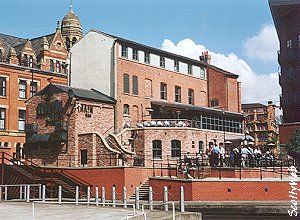
Rain Bar is a modern JW Lees pub inside a former Victorian warehouse.  It is so named as the building was also an umbrella factory before many years of dereliction.  Rain Bar opened in 1999 and is a decent addition to this part of town which boasts some great boozers such as the Peveril of the Peak, The Temple, Knott Bar and Britons Protection.


Rain Bar, Great Bridgewater Street. (c) Rain Bar.

The main part of the pub is the ground floor bar, decked out in wood and leather seating, whilst a second bar and function room on the first and second floor also have their own bars.


Rain Bar, Great Bridgewater Street (rear). (c) Scottyweb.

Cask Lees is a good pint these days and the Brewer's Dark mild is especially good and a better option than Guinness.  At the rear is a huge terraced seating area leading down to the Rochdale Canal which is very pleasant in the summer, although an insistence on plastic pots lets it down in this respect.


Rain Bar, Great Bridgewater Street, 2008. (c) markydeedrop at skyscrapercity.

Website:  www.rain-bar.co.uk.

Palatine, Hunts Bank


Palatine Hotel, Hunts Bank, 1894. (c) pittdixon.

The Palatine Hotel was Victoria Station's main railway hotel at the bottom of Hunts Bank, likely named after the Palatine Bridge over the Irwell, shown above in 1894 with a passenger steamer at the floating landing stage of the old Manchester Steamer Docks.   It's also seen here in 1908, looking towards the old Exchange Station, and is depicted in two drawings from the Archive.


Palatine, Victoria Street. (c) Google 2013. View Larger Map.

When it opened in 1843 the licence covered the Palatine and the station buffet bar (could be the same one that still just about exists today).  The hotel bar closed in 1910 when it was discovered that it was being used as a brothel and the manager was banned from holding a licence  It found use as a shop in the 1950s and '60s.  The building is still there as part of Chetham's School of Music [1], and the sign can still be seen as you pass on the train or crane your neck up from Victoria Street.

1. www.northmanchester.net/content/view/83/2.

Exchange Hotel, Fennel Street


Exchange Hotel, Fennel Street. (c) northmanchester.net.

The Exchange Hotel replaced three alehouses (as yet unidentified) which stood in this location on Fennel Street corner of the Corn Exchange (now The Triangle), behind Manchester Cathedral.  The Exchange Hotel lost its licence in 1945 [1] which is presumably when it closed.


Exchange Hotel location, Fennel Street. (c) Google 2010. View Larger Map.

1. www.northmanchester.net/content/view/83/2.

Metro Bar, Victoria Station


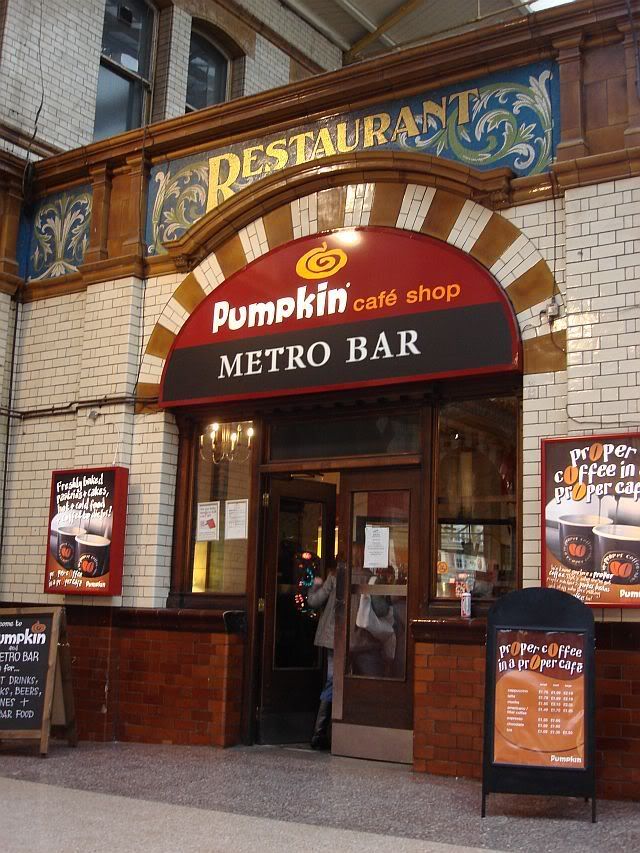
Metro Bar, Victoria Station, 2008 (c) markydeedrop at skyscrapercity.

This depressing place sits in what was once an opulent station pub many moons ago.  The Metro Bar is so bad we're not including it on the list of places to visit.  It probably wasn't much better in 1988. When you consider the great boozers at stations on the outskirts of Manchester - Stalybridge's Buffet Bar, Urmston's Steamhouse, Huddersfield's Head of Steam, etc. - it's a shame this place can't become a decent venue for a pre- or post-journey snifter.  Manchester Confidential even ran a campaign to try to sort this shithole out.

..
Metro Bar, Victoria Station. (c) Manchester Confidential.

Bonapartes, Piccadilly Station


Manchester Piccadilly Station entrance. (c) The Manchester Web.

I had countless pints in Bonapartes over the years whilst waiting for late trains, but when Piccadilly Station was substantially redeveloped in the early 2000s, this single roomed rail pub was lost.  It was on the left through the grim old entrance to Piccadilly, seen here in 1986.  The old Fairfield Street entrance was slightly less grim but was rarely used:

..
Piccadilly Station old entrance, Fairfield Street. (c) Both geograph.

Old Mosley Arms, Shudehill

Old Mosley Arms, Shudehill. (c) Manchester Local Image Collection. Click here to view full image.

The Old Mosley Arms stood next door-but-one to the more famous Rovers Return on Shudehill, seen here on the left, on the corner of Watling Street and Shudehill.  Shown here in 1958 as a Cornbrook Ales house, here with the Shudehill market outside in 1958, and here in 1970, the Old Mosley Arms was one of dozens of pubs lost during the destruction of old Manchester required for the building of the Arndale Centre.

017. Temple, Great Bridgewater Street


Temple, Great Bridgewater Street. (c) Pubs of Manchester.

The Temple is one of the more unusual pubs in town, as it's situated in an old underground Victorian public toilets!  It is situated just off Oxford Street, and as seen above in the distance, is in close proximity to two other decent pubs - the Peveril of the Peak and Rain Bar.  It can get rather cramped in here as there's only room for a dozen or so to sit down, but what it lacks in space it more than makes up for in character.  With a great jukebox, a 'quaint' unisex loo, celebrity regulars and a good selection of continental beers, it's a great little boozer.  

Temple, Great Bridgewater Street. (c) ooze.

We erred on the side of caution with a Guinness during our first visit but second time around bottled Black Sheep was on offer so we plumped for that; not bad but the cask version is superior.  The steps at both ends of the pub double up as extra standing capacity on busy weekend nights.  The Temple was previously known as the Temple of Convenience, a nod to its former usage.  If only some other famous underground toilets in Manchester could be converted into drinking holes...

..
Cathedral Steps, Victoria Street. (c) Both R0manian at photobucket.

Oxford, Oxford Street

The Oxford, Oxford Street. (c) Manchester Pub Surveys [1].

Shown here and here in 1905, the Oxford was a grand looking boozer as shown in its later days here in 1972.  It is looking busy here in 1974 and here in what was presumably just before its demolition in 1980.  It was situated next to the Rochdale Canal as it passes beneath Oxford Street.


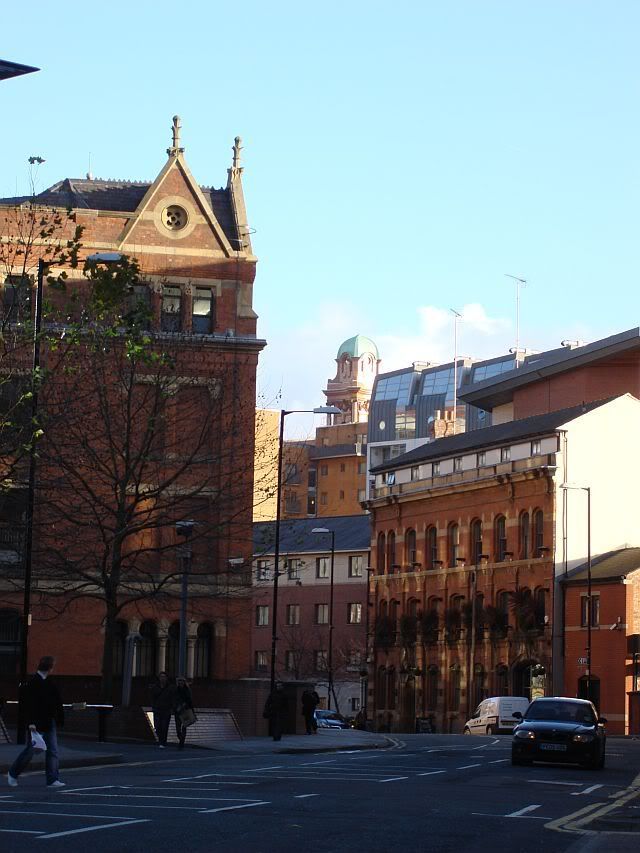
Felicini's, Oxford Street. (c) Google 2010. View Larger Map.

A seven-story apartment block replaced the Oxford, and the ground floor contains Felicini, an Italian restaurant. The view from the bridge is shown below.


Rochdale Canal from Oxford Street, 2007. (c) Gene Hunt at flickr.

1. The Manchester Pub Guide, Manchester & Salford City Centres, Manchester Pub Surveys (1975).

Friday, 5 February 2010

Vine, Jersey Street

Vine, Jersey Street, Ancoats. (c) Neil Richardson [1].

The Vine beerhouse stood on the corner of Jersey Street and Murray Street in old Ancoats.  It opened in the 1860s and closed as a Walkers of Warrington house in 1927 [1].


Vine, Jersey Street, Ancoats. (c). Ancoats Little Italy.

The Vine was bought from the brewery in around 1919 by Vincents, an ice-cream company [2], so common in Manchester's Little Italy.  It faced the Church Inn which is a more recent loss.

Vine, Jersey Street, Ancoats. (c) Ancoats Forever Facebook / Stella Barnett.

1. The Old Pubs of Ancoats, Neil Richardson (1987).

Thursday, 4 February 2010

Seven Stars, Withy Grove


Seven Stars, Withy Grove, 1877. (c) Greater Manchester County Records Office [1].

The Seven Stars once claimed to be the oldest public house in England, having stood here for 555 years - from 1356 to 1911 when it was demolished.  However, it was most likely predated by the nearby Rovers Return a few doors up on Shudehill.  Indeed it has been suggested that the builders of the Seven Stars had refreshments in the Rovers [1].  This 1885 photo shows how it was sandwiched between coffee and cheese merchants.  The Seven Stars stood pretty much where the Withy Grove entrance to the Arndale Centre now is, on the left of the below image.
.
Withy Grove. (c) Google 2010. View Larger Map.

The Archives also has some great interior photos of the Seven Stars - these 1885 shots show the vestry with 'oldest licenced house' boast, the bar, cellar with its Taylor Eagle barrels of ale and 'Ye Guy Faux Chamber'.  This was so-named because Guy Fawkes, the Gunpowder Plotter, was meant to have fled from time spent plotting at Ordsall Hall, a couple of miles away, to the Seven Stars via an underground tunnel.  Traces of a tunnel were known at the Hall, also at the Seven Stars, though this tunnel was believed to have been connected with Trafford Hall, a couple of miles even further away.  The fascinating Manchester Underground book contains a letter from Frederick Tavare who wrote to the CITY NEWS in 1892:

"(In the) cellars is visible an old arch, which is the reputed entrance to a secret passage which at one time is believed to have afforded subterranean communication with the old Collegiate Church, built in the fifteenth century (now the Cathedral), and thence, so tradition affirms, to the old Ordsall Hall, then the residence of the Radclyffes, a well-known Roman Catholic family. This secret passage, it is alleged, was, in the dim and distant past, not only made use of by the workmen at the Old Church, who received a penny a day for their wages, and got their dinners and other meals at the Seven Stars, but also played a prominent part in the escapades of the terrible Guy Fawkes, the never-to-be-forgotten hero of the Great Gunpowder plot.

It is said that Fawkes was concealed at the mansion at Ordsalll. King James's soldiers were in close pursuit, and Fawkes, reduced to the most pressing extremity, took to the secret passage, gained the Seven Stars, emerged into a room (still known to visitors as Ye Guy Fawkes Chamber), darted through a still existing trapdoor in the ceiling, and my means of a gloomy passage, now utilized by spirits of another sort, gained the street and liberty [1]."

A tragic story is behind a horseshoe which was nailed to a post inside the pub.  The story goes that in 1805 a farmer's servant was leading a shoe-less horse past the Seven Stars, holding the shoe.  As he passed by a Press Gang rushed out and detained him to serve in the army and fight Napoleon.  The servant asked the landlord to nail up the horse shoe, which he'd collect on his return from the war.  It was never reclaimed [1].

Map

1. Underground Manchester, Keith Warrender (2007).

Unicorn, Smithy Door


Smithy Door. (c) Geesnmore blog [1].

Smithy Door was once located on the present Victoria Street and the Unicorn pub was once home to the Punch Club [2], which is detailed in the entry for the Star Hotel on Deansgate.  When Victoria Street was established in 1838 the Unicorn was pulled down.


Smithy Door. (c) Geesnmore blog [1].

1. http://geesnmore.wordpress.com/gees-in-england/lancashire/manchester/streets-of-manchester.
2. Memorials of Manchester Streets, Richard Wright Proctor (1874).

White Lion, Long Millgate


White Lion, Long Millgate, 1875. (c) Greater Manchester Country Records Office.

The White Lion on Long Millgate was demolished in 1908 as seen here, and it probably needed it, as seen in this photograph from 1906 when it was virtually falling down.


White Lion, Long Millgate, 1889. (c) Alan Gall [1].

The White Lion is depicted here at the archives almost two centuries ago in around 1820.  On this site now sits Urbis, the exhibition centre, which has recently taken on the National Football Musuem.

Urbis, Cathedral Gardens. (c) evoke.

1. Manchester Breweries of times gone by, Alan Gall (year unknown).

Sun Inn, Long Millgate


Sun Inn, Long Millgate, 1865. (c) Greater Manchester County Records Office [1].

The Sun Inn used to face the entrance to Cheethams College on Long Millgate.  The pub was also known as Poets' Corner, due to its proximity to the College and the fact that the pub was used as a meeting place for many of Manchester's poets.  The pub is described in one such poet's biography, that of John Critchley Prince, in 1841:

"The Sun Inn was one of those ancient and picturesque houses which occasionally start to view like spectres of a bygone age, but are now fast disappearing before the levelling hand of improvement."

Sounds familiar when you consider the number of historic Manchester pubs that have been razed to the ground in the name of progress in recent years.


Poets' Corner, Long Millgate. (c) gerald-massey.org.uk.

"In external appearance is presents a singular contrast to the neat, uniform aspect of our modern mansions, being clumsily supported by irregular beams, and its walls being composed of dry clay and plaster. It exhibits great antiquity, in one place bearing the date 1612, apparently inscribed to commemorate some alteration having taken place. It is divided by awkward and ill-planned passages, such as are found in old habitations, though it contains one commodious apartment. 

The Sun Inn soon became, through Prince and other literary men, the rendezvous of the rhyming fraternity of the county, and the its quaint snug parlour, the 'commodious apartment' referred to, were attracted many a genial soul, poets and their satellites, who enjoyed the wit and humour, gossip and melody, which nightly its walls vocal [2]."

Sun Inn, Long Millgate. (c) Greater Manchester County Records Office [1].

At some point in the 19th century the Sun Inn lost its licence and was split into a book shop and a cake shop, before being finally demolished around 1889.


Long Millgate. (c) Greater Manchester County Records Office [1].

1. www.gmcro.co.uk. 
2. http://gerald-massey.org.uk/prince/c_biog_3.htm.

Three Tuns Alehouse, Apple Market (Long Millgate)

Three Tuns Alehouse, Apple Market. (c) Manchester Local Image Archive. Click here to view full image.

Several hundred years ago this little part of town around the Catherdral was once packed with pubs such as New Tavern, Dog & Partridge, Sun Inn, White Lion and the Three Tuns Alehouse.  This large, black & white timbered alehouse was built 1772, and it is depicted here in around 1820.  A tun is an Old English term for a barrel of beer, but the name "Three Tuns" relates to the Worshipful Company of Vintners, Worshipful Company of Brewers and the City of London Guilds [1].

1. www.british-pubs.com/pub_fun/5034e27faaf4e/The-Origins-of-Pub-Names.

Walcots / Rowntrees, Hanging Ditch

Walcots Cafe Bar, Hanging Ditch, 1990. (c) deltrems at flickr.

Walcots Cafe Bar in the Corn Exchange was previously known as Rowntrees, as shown here in 1965 and here close-up in the 1970s. The left hand side was the bar and restaurant, with a cafe snack bar to the right.


Rowntrees, Hanging Ditch. (c) Manchester Local Image Collection. Click here to view full image.

Next door  to Walcots and just apparent on the right was the infamous Top Cat Tavern, a real rough-arsed boozer.  The old Rowntrees / Walcots is now the still-popular Zinc Bar & Grill at 'The Triangle'.


Zinc Bar & Grill, Hanging Ditch. (c) Google 2010. View Larger Map.

Brahms & Liszt, Brown Street

Brahms, Brown Street. (c) New Manchester Review, 1979.

Brahms & Liszt (famous composers, but perhaps better known as rhyming slang...) was a popular bar back in the 1980s.  It is now Panama Hatties restaurant, having previously tried to make a go of it as Time, Chez Gerard and Renaissance.  As Brahms & Liszt it did sell cask Tetley's, but reportedly shut when the door wars came to Manchester. There appears to be a worldwide chain of Brahms & Liszts these days.

Panama Hatties, former Brahms & Liszt, Brown Street. (c) myvillage.

Maxwells / King's, King Street West

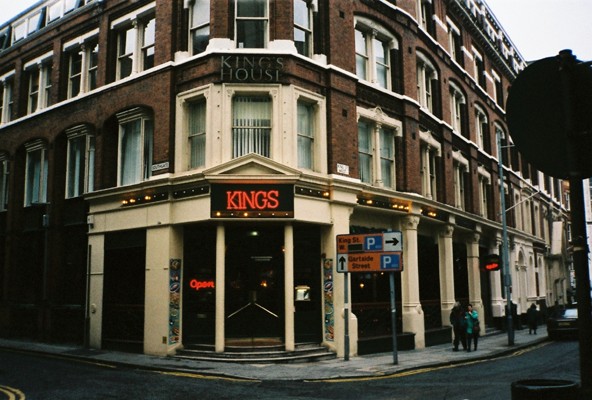
King's, King Street West. (c) Alan Winfield with permission.

Maxwells was one of the first café bar boozers, and was originally sited just near to Kendalls in the building now occupied by San Carlo.  Maxwells was one of the first to have genuine foreign lager on draught, and it served a purpose on occasion but wouldn't be the sort of place we'd now frequent.  It was called Kings for a time in the late 1990s, as shown above.  Maxwells was in the news in 1999 when Man Utd legend Roy Keane was arrested here having assaulted a female in Henry's.

San Carlo, King Street West. (c) gmgrd.

Rosies Bar, York Street

Rosie's Bar, York Street, 1990. (c) deltrems at flickr.

Rosies Bar was an odd but popular little bar that with time just got smaller and smaller.  Originally part of the Chef & Brewer chain as shown above, it eventually occupied just half of that overall space. It was popular with office workers during the day, part of the drinkers crawl at night, and a popular venue for football lads.  Rosies Bar closed for a time in 1995 following a brawl between City and United supporters after a Maine Road derby in which every bit of glass was smashed out of the frontage.  It shut for good about the same time as they were demolishing the Eagle Star building opposite, in the early 2000s.  It is now much-unchanged as a sandwich shop.


Former Rosies Bar, York Street. (c) Google 2013. View Larger Map.