Pubs of Manchester

All pubs within the city centre and beyond.
A history of Manchester's hundreds of lost pubs.

Wednesday, 3 February 2010

Portland Bars / Mosley Arms, Portland Street

Portland Bars, Portland Street, 1983. (c) Spitfire1 at Manchester District Music Archive.

Opened in 1965 as part of the hideous Piccadilly Plaza complex, opposite the Boardroom pub, the Portland Bars was an Ind Coope house as pictured above in the 1970s.  It played host to some local bands, and judging from the below 1980 photo, the decor was horrific. Paul Ryder, guitarist with the Happy Mondays, claims "In 1979-1980 Portland Bars was the Boardwalk of the day, with all kinds of unknown bands" [1] (the Boardwalk was a famous an indie venue on Little Peter Street).


Portland Bars, Portland Street, 1980. (c) Big Block 454 at Manchester District Music Archive.

I'm pretty sure we did venture in the Portland Bars few times as under-age drinkers - and it did do a good pint of cask ale by all accounts, even towards the end.  In seen here in on the corner of York Street in 1970, five years after opening, it was an Ind Coope house.  The 1849 map shows that before the Plaza was built, this stretch of Portland Street was just a row of terraced premises, with the one on the corner of Portland Street and York Street one being the Mosley Arms [2].


Former location of Portland Bars, Portland Street. (c) Google 2013. View Larger Map.

1. The North Will Rise Again: Manchester Music City 1976-1996. John Robb (2009).
2. Manchester (Piccadilly) 1849, Alan Godfrey Maps (2009).

Princes Tavern, Cross Street

Thomas de Quincey. (c) wikipedia.

The Princes Tavern was the birth place of Thomas de Quincey, the famous intellectual and author of Confessions of an Opium Eater. Some might say a pub in Manchester is a suitable place for a laudanum (alcohol and opium) addict to start his life.


Princes Tavern, Cross Street. (c) Manchester Local Image Collection. Click here to view full image.

The Princes Tavern was a big old pub on the corner of Cross Street and Princess Street near Albert Square, as shown in 1892, being refurbished in 1909 and with its new facade and sign in 1912.  The Princes Tavern was on this corner, and the office building is named De Quincy house today.


Former location of Princes Tavern, De Quincey House. (c) Google 2013. View Larger Map.

Ring O'Bells, Victoria Street

Ring O'Bells, Victoria Street. (c) northmanchester.net [1].

Where Victoria Street passes the Cathedral nowadays used to be just a footpath.  Between the path and the River Irwell on the left was the Ring O'Bells, a popular venue for wedding parties heading out of the Cathedral - it's mentioned in The Manchester Man as being filled to repletion with wedding guests [2].

Apparently there was a long room upstairs and from the window you could look down onto the boats on the river.  This room was described as "old, worm-eaten and dilapidated" with "step-dancing in perfection, and the beat of a Lancashire clog seems an excellent accompaniment to the violins".

The Ring O'Bells was shut in 1833 as the place had been "most infrequently conducted for a long time" [2].  This drawing shows the Ring O'Bells Tavern at the bottom of Hanging Ditch on the corner of Half Street.

2. The Manchester Man, G. Linneaus Banks (1896).

Slip Inn, Hodson's Court

Slip Inn, Hodson's Court. (c) F. Greenwood, courtesy of David Pryer [1].

The Slip Inn was near to the Blue Boar Hotel, and Blue Boar Court led onto Hodson's Court.  Hodson's Court is shown here in 1903, here in 1959.  That lamp in the 1959 photo could well be the Slip Inn's, as shown above in a marvellous drawing by F. Greenwood.  Hodson's Court is shown here as late as 1971, before it was lost to the building of the Arndale Centre.

1. F. Greenwood in The Story of the Old Wellington Inn, Cornbrook Brewery, 1950.

St Matthews Tavern, Tonman Street

St Matthews Tavern, Tonman Street. (c) Manchester Local Image Collection. Click here to view full image.

St Matthews Tavern was named after the impressive St Matthews Church which once stood in the Castlefield area just off the lower end of Deansgate around Liverpool Road.  It is seen here in 1949 and here with the White Lion pub on the right in 1955.  The pub itself was fairly nondescript as shown in these two photos from the 1970s - the only indication is the small Whitbread tankard sign.  It was next-door-but one to the Haymarket Tavern as shown on the right in this map from Manchesterhistory.net.


St Matthews Church, Castlefield, around 1830. (c) Antique Maps and Prints.

Crown, Byrom Street

Crown, Byrom Street, 1965. (c) Frank Heaton/Neil Richardson [1].

Seen here in 1959 as a Wilson's house, the Crown stood where the new Spinningfields development is rising on the west side of Deansgate. The Crown was run by Ethel Hamer in the 1930s and was known as Top Hamer's and later after she'd died, Tommy Hamer took over.  The beerhouse is described as being popular and very old-fashioned, with a lobby and a vault on the right for darts which had sawdust on the floor. To the left were two best rooms, the larger one with a piano [1].  The New Theatre Hotel stood opposite the Crown on Hardman Street.

The Crown was the most popular boozer in the area with Opera House players and patrons, and at the interval there would be an exodus from the stage door as stage hands and band members would rush over - it was known as "the Opera House stage door" locally.  Pints were lined up on the bar and folk tended to have a couple each despite the interval only lasting 10 minutes.   It was also a popular haunt of the Daily Mail journalists who took their dinner hour at 9:30pm and they would dash down Hardman Street for a pint or four [1].  This 1947 shot shows Byrom Street just past the Crown when the area was a busy shopping and residential part of town.

1. The Manchester Village: Deansgate Remembered, Frank Heaton/Neil Richardson (1995).

Tuesday, 2 February 2010

016. City Arms, Kennedy Street


City Arms, Kennedy Street, 2010. (c) Pubs of Manchester.
.
An Empress Brewery house in the 1930s, Walkers in the '70s, and by 1994 a Tetley's house with a garish facade, this is the middle, the smallest, and the best of the three-in-a-row of the Waterhouse, City Arms and The Vine. The small front room and bar area leads to a little cavern-like back room down a few steps. The range of great ales on offer - about 8 handpumps - is impressive for such a small place, and accounts for its popularity - the post-work rush and weekends regularly sees trade slip out onto the street.
.

City Arms, Kennedy Street, 2009. (c) garstonian at flickr.
.
It had been a long old day by the time we visited and as such I'm struggling to recall which ale we had, but rest assured it was gulped down promptly. [Edit: it was Batemans XB]. In an area of town well-off for pubs, this is definitely one of the better ones and a must-visit.
.

City Arms (centre), Kennedy Street, 2008. (c) markydeedrop at skyscrapercity.
.

City Arms, Kennedy Street. (c) asaph_art at flickr.

015. Shakespeare, Fountain Street


Shakespeare, Fountain Street, 2010. (c) Pubs of Manchester.

The Shakespeare as an Inn has stood on this site just off Market Street since 1771, but the pub standing here now may be even older. Apparently it was originally The Shambles Inn in Chester, 40 miles away. It was dismantled and brought to Manchester and reassembled here in the 1920s [1]. A slightly less dramatic version of this story is that the Tudor timber and carvings did indeed come from the Shambles in Chester, but were just added onto the already standing Victorian Shakepeare building in 1928. The pub is reputed to be haunted by the ghost of a young girl who was raped and murdered by the chef, who subsequently went on to hang himself in the pub. The rope marks where he hung himself are reportedly visible on the ceiling beam inside the pub - however as we'd already sunk a few halves before our visit we thankfully forgot to look out for this macabre feature. The ghost is reported to stand at top of the stairs in the pub, appearing to be on fire [2].
.
A Wilsons pub in the '50s through to the '70s, it's a free house now and a bit of a rarity was on offer, cask Boddies. It was decent enough but nothing comes close to the creamy yet bitter Boddies that was available all over town in the '80s through to the end of the century when Boddingtons then-owners, Whitbread/InBev, made the terrible decision to wind down the Strangeways Brewery. Smaller volumes of this once great cask ale are now brewed at the Hydes brewery in Moss Side. The Shakespeare was busy enough on a Sunday evening, and despite the slightly shabby interior, it retains some charm and is worth a pint if you're passing.
.

Shakespeare, Fountain Street, 2007. (c) joseph mcgarraghy at flickr.
.
Website: www.pub-explorer.com/lancs/pub/shakespearemanchester.htm
.
1. www.manchester2002-uk.com/eat&drink/pubs/manc-pubs5.html
2. www.paranormaldatabase.com/gallery/north5.htm

014. Unicorn, Church Street


Unicorn, Church Street, 2010. (c) Pubs of Manchester.

Back street pub on the fringes of the Northern Quarter that has been unchanged for as long as I can remember. Once a favourite haunt for the nearby marketeers and barrow boys, those days are now long gone and theyve been replaced with a pub full of older folk (maybe former barrow boys and girls?) Usually been known to serve a good pint, unfortunately for us on our recent visit, all cask ales were off due to cellar problems(?). Guinness makes a good substitute for a one off, but hopefully normal service will be resumed at our next visit. The pub itself is split into two main rooms, though both tend to have the same sort of crowd. Very much a locals place, there was no problems with a few visitors, but it clearly surprised a few of the locals. Seen below 20 years ago as a Bass house, the first thing you notice on the bar as you walk in is a cracking '70s Bass Mild clip.
.
.
Unicorn, Church Street, 1990. (c) deltrems at flickr.

Map

013. English Lounge, High Street


English Lounge, High Street, 2008. (c) deltrems at flickr.

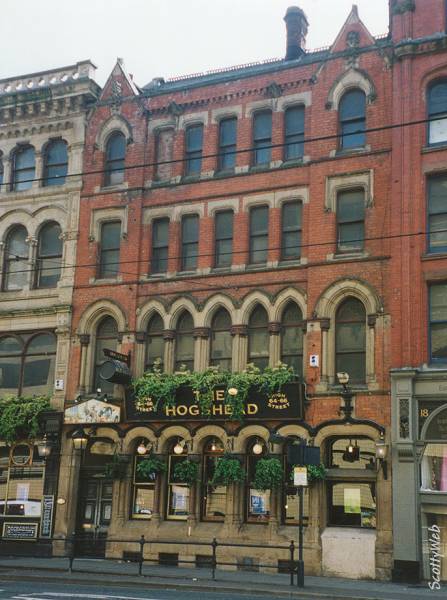
Previously the Old Wheatsheaf Hotel, then simply the Wheatsheaf as seen here in the '70s, the Hogshead, then Bensons and then the Hogshead again, this pub has surprisingly stood the test of time well. Slightly reinventing itself at each opportunity has provided a different customer base depending on the current era and target market. Currently, it's a pleasant food restaurant upstairs, snack meals available downstairs and a decent place pop in for a pint, maybe only for a couple though.


Bensons, High Street, 1990. (c) deltrems at flickr

In summer they have converted an upstairs roof area into a smoking area which has an interesting feel to it, and the food I'm told is very good.  They had three real ales on at out last visit, the one I had was perfectly palatable and at the right temperature, so full marks to them for that.  The Director's - not normally a favourite on cask - was also on good form.  I suspect however for most, it's more likely to be a stopping off for a pint or two sort of place rather than one for a long session, due to the family feel of the place.

Hogshead, High Street. (c) Scottyweb.

012. Hare & Hounds, Shudehill


Hare & Hounds, Shudehill, 2010. (c) Pubs of Manchester.

Cracking little boozer on Shudehill, just behind the old fish markets, formerly a Tetleys house (seen here in the 70s), but now a freehouse serving mainly Holts. The original Tetley signs can still be seen, however the Tetley lanterns in the above photo have now been replaced by Joey Holts ones.


Hare & Hounds, Shudehill, 2010. (c) Pubs of Manchester.
.
The place itself is something of a timewarp, with three very different rooms. The front room, probably regarded as the best side is probably the quietest but still with access to the bar, as shown below (ashtrays!), and you can still hear the music but only from a distance.
.
Hare & Hounds, Shudehill, 2007. (c) Mickaul at flickr.

The main room is where you first enter the main bar, with tiled floors and walls, it's full of traditional charm. Finally there is the back room which is always full. If you've ever fancied watching pensioner kareoke, this is the place for you. Also bingo on a Thursday and singalong on a Sunday. As for the beer, superbly kept and at £2.10 a pint, what more could you want! Post-script: mention must be made of the rather odd closed-shop meeting that was going on in the front room during our visit here. A dozen or so skinheads dressed in black, most with interesting tattoos, one of which was undergoing some sort of initiation ceremony while his missus was outside in the corridor. I'll give them the benefit of the doubt and hope it wasn't what it looked like; perhaps some goth / heavy rock music appreciation society?
.

Hare & Hounds, Shudehill, 1990. (c) deltrems at flickr.

Monday, 1 February 2010

Robin Hood, London Road

Robin Hood, London Road. (c) Manchester Local Image Collection. Click here to view full image.

On the corner of London Road and Fairfield Street, as seen here in 1969 and here in the 1970s, was the Wilsons house, the Robin Hood. Eagle-eyes may also spot the dual branding for London's terrible Watneys brewery on the busy pub frontage, not to mention the upside down plastic Wilsons sign.  The Robin Hood was roughly opposite the still open Bulls Head, and was pulled down several decades ago to make way for the expanding Piccadilly Station.

011. Seven Oaks, Nicholas Street


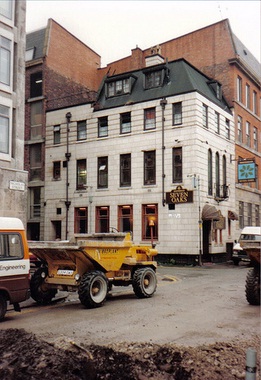
Seven Oaks, Nicholas Street, 2008. (c) markydeedrop at skyscrapercity.
.
Seen here in the '70s, the Seven Oaks in Manchester's small but busy Chinatown area is a traditional old back street boozer, dating back to 1824. Described as being packed with "chavs, old soaks, United hooligans and nutters" elsewhere, it's had a reasonable crowd in whenever I've visited and a huge screen shows all the sport. It's most definitely a red pub, and it is here that the ultimately unsuccessful "Not For Sale" campaign was launched in 2003 (but now reds definitely want them sold!). The Cumberland cask, one of a couple of ales on, was a touch cloudy but went down alright.

Seven Oaks, Nicholas Street, 1990. (c) deltrems at flickr.

Horse & Jockey, Store Street

Horse & Jockey, Store Street. (c) Manchester Local Image Collection. Click here to view full image.

The Horse & Jockey was opened in the 1830s by Thomas Scragg.  It was a Boddingtons house, shown here and here in 1896 on the corner of Store Street and Stand Street (now lost).  A few years after these photos were tajen it was a pub no more, shown here in 1908, three years after losing its licence [1].  The site of the Horse & Jockey was where the garage is on Store Street on the corner of Sparkle Street.

Location of Horse & Jockey, Store Street. (c) Google 2010. View Larger Map.

1. The Old Pubs of Ancoats, Neil Richardson (1987).

Railway Mens Club, Store Street


Warehouse Project, Store Street. (c) Mancubist.

The Railway Mens Club was an odd little rail boozer beneath Piccadilly Station was situated to the left of the old Store Street tunnel pedestrian's entrance up to the station.  That entrance is seen here in 1900, and the club was to the left.  The Central Manchester Brass Band played concerts in the club until 1994/95 [1].  I had a pre-match pint in here in the early-mid '90s, but it closed probably around 1996 and it's now boarded up - the pub could well still be intact behind.


Warehouse Project, Store Street. (c) Clash Music.

Also in the tunnel part of Store Street is the entrance to the occasional Warehouse club right under the station, a huge venue where the odd rave was held until recently.


Former location of Railwaymens Club, Store Street. (c) Google 2013. View Larger Map.

The murky shot above shows the old station steps, right, and the old club entry barely visible about 10 yards to the left (centre of shot).

1. www.ibew.org.uk/misc23.htm.

Red Lion, Red Lion Street


Red Lion, Red Lion Street, 2008. (c) Gene Hunt at flickr.

The Red Lion stood here from the early 19th century until the early to mid 20th century.  I'm not sure if the pub took up the whole building shown or just the left side.  The section to the right was once a gallery, where it exhibited sets from the excellent but underrated BBC series, Cutting It.  
.

Red Lion, Red Lion Street, 2008. (c) Gene Hunt at flickr.

There is barely a record of this pub anywhere, and only the road's name led us to suspect the building was a pub, as we clocked it leaving the Unicorn, from this view:

Red Lion, Red Lion Street (2). (c) Google 2010. View Larger Map..

010. Bank, Mosley Street


The Bank, Mosley Street, 2010. (c) Pubs of Manchester.

Originally the Portico Library (still in evidence upstairs) and for a time, the Forgery & Firkin chain pub, the history is as follows:

"The Portico Library in Mosley Street is the only surviving work in Manchester by Thomas Harrison. Promoters of a scheme for a combined newsroom, circulating library and reading room visited the Athenaeum in Liverpool in 1799 or 1800. This may have been how they came into contact with Harrison whose Lyceum was built there 1800-04. The Portico is Manchester's earliest Greek Revival building and in incorporates a partially intact Soane-inspired interior. To Mosley Street four columns, based on Stuart and Revett's drawings of the Little Temple on the Illisus. On the side to Charlotte Street a rank of attached columns and ground floor windows, all done in the finely finished Runcorn stone. The steps up to the Ionic Portico and the recessed entrance emphasise the exclusive nature of the club, but today they lead to a disappointing pub conversion."
.
This is a bit harsh, as the conversion has tried to remain respectful to the building's past, and has some great pictures and even a potted history on the menu stand outside on the street.

"The ground floor was the newsroom, and there was an open well with a galleried first floor. This was closed in and floored over in the 20th century. The library upstairs is preserved and is now reached from a side entrance. Here the space is dominated by a dome with late coloured Victorian glass, and segmental tunnel vaults. Harrison presumably knew Soane's Bank of England in London, and he may have had contact with Soane through his membership of the Architects' Club. The library and its fittings are intact, and the library continues in use [1]."


The Portico Library, Lower Mosley Street. (c) Looking at Buildings.
.
Famous members of its subscription-only library included John Edward Taylor, founder of the Manchester Guardian, authors Elizabeth Gaskell and Charlotte Bronte, and scientists John Dalton and James Prescott Joule. The post box on the Portico Library is the oldest in town [2]. Before becoming a pub it was a bank for a time, Lloyds Bank's Overseas Department being resident for a time from the 1920s, and seen here in 1973. Before becoming the Bank pub, it was, for a short time, the Forage & Firkin, one of the chains that were quite successful in the '80s and '90s.
.
As a pub, it is a large spacious place with lots of places to sit. When we visited there were five real ales on together with all the usual other suspects. They also had a good selection of continental lagers on draught also. Popular during the day with shoppers and office workers, and with a slightly younger crowd at night. The food looked okay, and their speciality is many different kind of sausages although we didn't try any of these. Not a bad pub, a little soulless, however a fantastic building in which it is housed, and the added bonus of 10am opening.
.
.
2. Manchester Then & Now, Johnathon Schofield (2009).

009. Waterhouse, Princess Street


Waterhouse, Princess Street, 2010. (c) Pubs of Manchester.

The most recent addition of the Wetherpoons houses in the city centre, which sits in the shadow of the Town Hall, designed by Albert Waterhouse.

Waterhouse, Princess Street, 2009. (c) BinaryApe at flickr.

It is a strangely laid out pub due to its previous function as a solicitor's office, in that sometimes it feels that there are more rooms than customers. However, to be fair to it, this is the best of the five Wetherspoons in Manchester and doesn't really feel like one of their standard type houses. The beer selection was also excellent with six different real ales on and the beer was the right temperature well kept for a Spoons. The young barman seemed to know his stuff. As with all Wetherspoons, it also opens early so you can have beer with your breakfast; useful when it's an early kick-off that day. The Waterhouse does decent trade, despite its location next to two of Manchester's better alehouses, the City Arms and The Vine, on Kennedy Street.


Waterhouse (& neighbours), 2008. (c) markydeedrop at skyscrapercity.


Waterhouse & City Arms, Kennedy Street. (c) asaph_art at flickr.

008. Beluga, Mount Street


Beluga, Mount Street, 2008. (c) Osdog LRPS at flickr.

Café bar / restaurant sat on the corner of Mount Street in a Grade II listed building, just behind the Manchester Central Library and well placed for the tram station at St Peters Square. Bit of trendy bar and as such is suitably expensive. As to be expected, there is no real ale on sale here, though Guinness is available. Formerly Juice Bar and Citrus Bar, this was visited only because we have to! A summer 2010 offer in here is UNLIMITED wine for 90 minutes with your three-course meal at £19.99 a head. Our kid was boasting that six of them got through seven bottles of white the other day, bless her - and the waiter was positively encouraging them to top up at all times. I'd be unhappy with less than a couple of bottles of claret per head from us chaps.
.

Offer at Beluga, Mount Street, 2010. (c) beluga.

007. Britons Protection, Great Bridgewater Street


Britons Protection, Great Bridgewater Street, 2010. (c) Pubs of Manchester.

A fine pub sat just behind the Bridgewater Hall and one of the oldest surviving pubs in Manchester, licensed since 1806 as the Britons Protection, but actually the Ancient Briton before that from 1795 [1].  These images from the archive show it before and after a clean in 1959 and 1970.  With a large front room and then two smaller rooms at the back, this is something of a hidden gem, and with its always closed front door, somewhere that some people wouldn't think of entering.  To do this would be a crime, as the pub is one of the best examples of a real pub that you will come across.  Make a point of looking at the artwork displayed on the corridor walls as well, with many depicting the Peterloo Massacre at St Peter's Field in 1819.


Peterloo Massacre, "The Massacre of Peterloo or Britons Strike Home" by George Cruikshank. (c) Spencer Arnold/Getty.

The beer is kept in superb condition and there is always a varied selection of real ales on.  On our first visits, there were six ales on, together with the usual suspects of lager and Guinness.  The Protection also specialises in whisky, keeping over a hundred different single malts.  Always busy, you can sometimes struggle to find a seat, but don't let this put you off as one will become available sooner or later.  There is also a decent yard out the back with plenty of seating which often acts as overspill for the weekend crowd.


Britons Protection, Great Bridgewater Street. (c) Manchester Pub Surveys [2].

The prices are possibly a little higher than average, but in this case, its worth paying a bit extra for excellence.  There is a reason why this classic Mancunian boozer is always rammed despite being a bit out on a limb - well, three: quality product, quality decor and quality custom.  A bonus during our first visit of the year was bumping into local musician and Elbow frontman, Guy Garvey; clearly a man of taste.
.

Britons Protection, Great Bridgewater Street, 2009. (c) deltrems at flickr.

1. www.northmanchester.net/content/view/69/2.
2. The Manchester Pub Guide, Manchester & Salford City Centres, Manchester Pub Surveys (1975).

Saturday, 30 January 2010

Kensington, Port Street

Kensington, Port Street (from Newton Street). (c) Neil Richardson [1].

Previously known as the Old Windmill and Sir Sidney Smith (an admiral in the French Wars), the Kensington was closed in 1986 for rebuilding and doesn't appear to have lasted much longer.  The pub's Port Street side can be seen in the 1970s and 1989, while its Newton Street entrance is photographed in the '70s.  As shown below, the building was pulled, leaving the Corriebest building from the 1989 photo standing alone (Crown & Anchor, Hilton Street in the background).


Former location of Kensington, Port Street. (c) Google 2010. View Larger Map.

1. The Old Pubs of Ancoats, Neil Richardson (1987).