Pubs of Manchester

All pubs within the city centre and beyond.
A history of Manchester's hundreds of lost pubs.

Showing posts with label - Hulme estate pub. Show all posts

Sunday, 29 November 2015

Unicorn, Shawheath Close


Unicorn. Shawheath Close, Hulme (c) Tim Martin with kind permission.

The Unicorn was a strange-looking Greenall Whitley's estate pub on Shawheath Close in Hulme.  It was built in 1968 so was one of Hulme's first new-wave estate boozers [1].


Unicorn. Shawheath Close. (c) Tim Martin with kind permission.

The odd but impressive Unicorn "horn" that the pub sported is seen twice from different angles in 1972 - note the off-sales entrance next to the lounge.

Unicorn. Shawheath Close. (c) kevinfromHulme at exhulme.

Unlike many of Hulme's estate pubs, the Unicorn has lasted, although today it is a sorry sight.


Former Unicorn, Shawheath Close. (c) Google 2014. View Larger Map.

In 2011 it appeared to be being used as a club or religious place of some sort, but by 2014 was derelict.

Former Unicorn, Shawheath Close. (c) Google 2011. View Larger Map.

The Unicorn's horn ias still partly evident - or at least its base is.  Alan Winfield has another colour photo of the Unicorn over at pubsgalore.

Former Unicorn, Shawheath Close. (c) Google 2015. View Larger Map.

1. The old pubs of Hulme and Chorlton-on-Medlock, Bob Potts (1997).

Thursday, 22 October 2015

Seahawk, Bold Street

Seahawk, Bold Street, Old Trafford. (c) Richard Aldred at BBC.

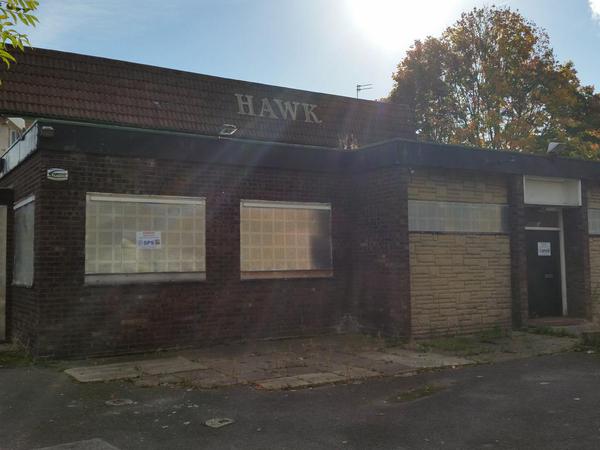
The Seahawk is the last of Hulme and Old Trafford's estate pubs to close. A vast area that once boasted 17 new-build pubs to serve the new housing estates, plus untold older boozers, is now virtually a pub-free zone.

Seahawk Lounge, Bold Street. (c) Anthony P Bruce at flickr under Creative Commons.

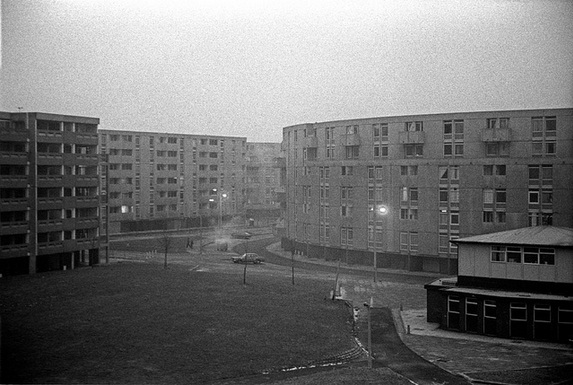
The Seahawk battled on as the 'Seven Sisters' flats that surrounded it were reduced to three, with the demolition of Raven, Osprey, Falcon and Eagle Court tower blocks. 

Seahawk, Bold Street. (c) The Nubian Times [1].

Towards the end the pub only opened at 7pm on selected evenings, and even then it was just the lounge that opened, as the Seahawk Lounge.

Hupton Harriett, Seahawk, Bold Street. (c) The Nubian Times [1].

Sadly landlord, Hupton Harriett, who'd run the Seahawk for 16 years, shut the doors for the last time on 7th January 2015, as the pub was acquired by Trafford Housing Trust for demolition [1].

Seahawk, Bold Street, 2015. (c) Duncan Morton @numlash at twitter.

Saturday, 13 August 2011

Star, Bentinck Street

Star, Bentinck Street, Hulme, 1992. (c) With permission from Alan Winfield.

Built in about 1975 to serve the regenerated Hulme estates, the Star was a Scottish Brewers house.  The original Star Inn on Bentinck Street off Chester Road stood on this corner and closed in 1974 as its estate pub replacement was being planned [1].  


Former location of the Star, Bentinck Street, Hulme. (c) Google 2012. View Larger Map.

1. The Old Pubs of Hulme and Chorlton-on-Medlock, Bob Potts (1997).

Grey Parrot, Jackson Crescent

Grey Parrot, Jackson Crescent, Hulme. (c) kevinfromHulme at exhulme.

The Grey Parrot was a 1969 Greenall Whitley estate pub built on Jackson Crescent in Hulme.  It replaced an original Cronshaw / Groves & Whitnall Grey Parrot on Bedford Street, seen here in 1961.  Thus Grey Parrot closed in 1963 when the first Hulme regeneration was in progress.

Former location of Grey Parrot, Jackson Crescent, Hulme. (c) soulboy at bluemoon.


Replacing it was this typically functional but ugly estate boozer, adjacent to the Aaben Cinema and north of the Crescents, not far from the Mancunian Way.  The Grey Parrot closed in about 1988 and has been demolished with the road layout much-changed around this part of Hulme.  There is a nice colour photo of the Grey Parrot by Alan Winfield at pubsgalore. 


Grey Parrot, Jackson Crescent, Hulme. (c) kevinfromHulme at exhulme.

Monday, 8 August 2011

White Horse, Stretford Road


White Horse, Stretford Road, Hulme, 1984. (c) dubwise-er at Manchester District Music Archive [1].

Two archive photos from the 1970s of the White Horse on Stretford Road in Hulme show a Tetley's estate pub with distinctive brick and wooden panelled façade.  The photos shown here are from the Hulme Festival, thanks to the brilliant Manchester District Music Archive [1], including one of local group, The Inca Babies playing in front of the White Horse.

White Horse, Stretford Road, Hulme, 1983. (c) dubwise-er at Manchester District Music Archive [1].

Having been built in 1970 to replace the original White Horse, the pub was built to serve the Hulme Crescents, located as it was between Charles Barry Crescent and John Nash Crescent, next to the Zion Centre.  The new White Horse lasted just 25 years before being demolished in 1995 as the area underwent another regeneration.

Former location of the White Horse, Stretford Road, Hulme. (c) exhulme [2].

Hussar, Epping Walk


Hussar, Epping Walk, Hulme. (c) NWfilmarchive at vimeo.

Not sure if this Hulme estate pub was actually on Epping Walk, but it was close by.  The Hussar is shown here in 1971 tucked in between high rise and low rise council flats.  It was one of Hulme's first estate pubs and was named after the King's 15th Hussars that served at the nearby Cavalry Barracks, now Barrack Street Park / St George's Park. Ironically, this Hussar and the old Fifteenth Hussar which once stood on Portland Street in town, were named after the cavalry that were implicated in the Peterloo Massacre in St Peters Square.  Believe it or not, when the Hussar pub opened in the late 1960s, the actual 14th and 20th Hussars arrived in a couple of tanks and let locals kids play on them [1].

1. http://www.skyscrapercity.com/showthread.php?t=282421&page=21.

Saturday, 6 August 2011

Mancunian, City Road

Mancunian, City Road, Hulme. (c) kevinfromHulme at exhulme.

The Mancunian was a Marston's estate pub in the St George's part of Hulme, situated at the convergence of Royce Road and City Road. Seen here in 1970, from the same angle today it's clear that these new build flats have replaced the Mancunian.

Former location of the Mancunian, City Road, Hulme. (c) googlemaps.


Although not much to look at - a one storey boozer with two storey house attached - the Mancunian did have a smart-looking sign out front.  It looks like it's an attempt at recreating the Manchester ship, as featured on the Coat of Arms symbolising trade and enterprise.  There is a colour snap of the Mancunian byAlan Winfield at pubsgalore.
. 
Mancunian, City Road, Hulme. (c) kevinfromHulme at exhulme.

Friday, 5 August 2011

Spinners Arms, Robert Adam Crescent

Spinners, Robert Adam Crescent, Hulme. (c) www.exhulme.co.uk.

Famous for having a model mermaid behind the bar, the Spinners also suffered a shooting and ram-raid during its time serving the Hulme Crescents and surrounding estates.  It was regarded as a bit of a Rasta's pub and was known as a place to easily score drugs - which may have been one of the reasons it was closed down in the early '90s.  As seen on the superb aerial photos of old Hulme, the Spinners was at the southern tip of the Robert Adam Crescent - the pub went the same way as the flats and is now the site of a car park.

Former location of the Spinners, Robert Adam Crescent, Hulme. (c) www.exhulme.co.uk.

Friday, 29 July 2011

Iron Duke, Clopton Walk


Iron Duke, Clopton Walk, Hulme. (c) seva_nmb at flickr.

The Iron Duke was sited to the West of Charles Barry Crescent on what I think was Clopton Walk.  Both pub and street are long gone since the demolition of the disastrous Hulme experiment in social engineering of the 1970s and '80s.


Iron Duke, Clopton Walk, Hulme. (c) seva_nmb at flickr.

The Iron Duke was a Bass house, built into the row of council house type shops.  The pub is shown at 3m20s in this great video tour of Hulme by bicycle.  Alan Winfield has posted a great colour photo of the Iron Duke in all its functional glory at pubsgalore.

Eagle, Robert Adam Crescent

Eagle, Robert Adam Crescent, Hulme. (c) www.exhulme.co.uk.

The Eagle was one of the most notorious of the Hulme Crescents boozers, sandwiched in between Robert Adam Crescent and William Kent Crescent.  A classic, rough looking estate pub, this tale from iRich at the www.exhulme.co.uk site gives us a clue of what it was like:

Eagle, Robert Adam Crescent, Hulme. (c) nualabuyeye at flickr.

"None of us had ever been into Hulme and we were all stoned and basically soft punk students in leather jackets. We got a bus from Old Trafford that used to go through the Crescents and wandered about in this Stalinist Orwellian nightmare of a place, on a dark freezing winters night, increasingly paranoid of the shadows. It was quite intimidating on first experience, particularly at night. Anyway, we found the Eagle (like a large Dulux tin made into a pub if I recall) and staggered in." 

Eagle, Robert Adam Crescent, Hulme. (c) www.exhulme.co.uk.

"The people in the pub were like inmates from an insane asylum. First of all, the mad Irish pool playing dwarf ex- boxer who kept coming up to me whilst I was trying to vanish into the wall. Smacking his fist into his palm and shouting "fair play, foul play" at me whilst staring at me with mad red chicken eyes."  

Eagle, Robert Adam Crescent, Hulme. (c) spanbeam at flickr.

"The unbelievable heavy metal Rasta guy tripping off his head, dancing in the middle of the pub to a tune in his own head with a chair and the arse completely ripped out of his jeans.  It must have had an effect cos I moved into Epping Walk within a year. Never went back to the Eagle though, I reckon I had some post-traumatic herbal disorder that evening."

Eagle, Robert Adam Crescent, Hulme. (c) Alan Denney at flickr.

In the 1970s the Eagle was ran by the famous '70s wrester, Honeyboy Zimba, who fought Big Daddy and the like.  The pub is pictured here, probably in the 1980s, as a Buzard house.

Eagle, Robert Adam Crescent, Hulme. (c) spanbeam st flickr.

Wednesday, 27 July 2011

Manchester Regiment, Hulme Hall Road

This Hulme estate pub sat over Chester Road on Hulme Hall Road where it crosses Ellesmere Street, photographed in technicolour by Alan Winfield for Pubs Galore.  It was a Greenall Whitley pub and was set back just off Chester Road, facing the factory with arches windows which still stands today.


Manchester Regiment, Hulme Hall Road, Hulme. (c) kevinfromHulme at exhulme.

The patch of wasteland to the right in the below shot marks the site of the old Manchester Regiment.  This part of Hulme near to the River Irwell is known as St George's and is undergoing slow regeneration, part of which involved the demolition of the Manchester Regiment only a couple of years ago after a long time boarded up.

Chequered Flag, Boundary Lane

Another of Hulme's new-build estate pubs, the Chequered Flag seen here in 1972 was a Tetley's house built to serve the new but ultimately ill-fated communities of the regenerated Hulme.  It has been described a "strange place full of ne'er do wells", "a mental institute with beer and prescriptions" and the sort of pub you'd bump into the bloke who'd just tried to mug you on the Crescents.  It was on the now lost Harvington Walk, with Brackenbury Walk to the rear, just off Boundary Lane and Arnott Crescent.  It's been demolished for years now but still crops up on the odd Manchester pub listings website.

Chequered Flag, Boundary Lane, Hulme. (c) robspankthemonkey at bluemoon.

Sunday, 24 July 2011

Falstaff, St Wilfrids Street

Falstaff, St Wilfreds Street, Hulme. (c) Alan Winfield with permission.

The Falstaff was one of Hulme's many ugly new-build estate pubs that were built to serve the council's misguided attempts post-war Hulme estates.  Replacing an existing Sir John Falstaff / Falstaff Hotel on the lost Bedford Street, It was sited next to St Wilfrids Church, which is pictured and described at the Manchester History site [1].  Its proximity to the church is shown here in the 1970s, here confirming it as a Watney's house, and this one shows the kind of council houses it once served.  It was later a Wilsons house offering cask Bitter and Mild when photographed by Alan Winfield for Pubs Galore [2].  At least the site of the old pub is put to good use these days as a football pitch, off Jackson Crescent, just south of the Mancunian Way near the Chester Road roundabout.

 
Falstaff, St Wilfreds Street, Hulme. (c) Jonnyboy Smith at Facebook.

1. http://manchesterhistory.net/manchester/outside/stwilfrids.html.
2. www.pubsgalore.co.uk/pubs/74702/.

Friday, 22 July 2011

Sir Henry Royce, Chichester Road


 Sir Henry Royce, Chichester Road, Hulme. (c) Mick Pye.

The newly built Whitbread house, the Sir Henry Royce, is seen here next door to the old Chesters house, the Nelson Inn which it was replacing, and then 14 days after its opening in 1973.


Sir Henry Royce, Chichester Road, Hulme. (c) Mick Pye.

The Sir Henry Royce, named after one half of the Rolls Royce due which had their first factory in Hulme, was an estate pub for the Hulme Crescents.


Sir Henry Royce, Chichester Road. (c) www.exhulme.co.uk [1].

As the estate remains notorious in Mancunian history, the pub also sounded like a lively place for a sup, thought it was also used as a pre-PSV Club (aka The Factory) drinking hole in the '70s and '80s.


Sir Henry Royce, Chichester Road. (c) Al Baker Photography [2] at Manchester District Music Archive [1].

The pub was demolished when this whole area of Hulme was put down as a bad idea and completely redeveloped in the 1990s, and is unrecognisable today, around the back of ASDA in Hulme just off the Parkway.

Sir Henry Royce, Chichester Road, Hulme. (c) Graffiti Walls [4].

Sir Henry Royce, Chichester Road. (c) Al Baker Photography [2] at Manchester District Music Archive [3].

1. www.exhulme.co.uk.
2. www.albakerphotography.com.
3. www.mdmarchive.co.uk/archive/homePage.php.
4. www.graffitiwalls.co.uk/indexHulme.html.

Sunday, 19 June 2011

Gamecock, Boundary Lane

Gamecock, Boundary Lane, Hulme. (c) Adam B. at flickr.

A distinctive and oddly-shaped 1970s estate pub that has been shut for a number of years now, the Gamecock stands in the shadow of some of Hulme's surviving flats on the corner of Boundary Lane and Booth Street West.

Gamecock, Boundary Lane, Hulme, 1975. (c) Neil Richardson [1].

There are rumours that yet more student accommodation will be built on the site of the Gamecock, a pub which has only stood here since 1974 when it opened as a Wilson's house, and seen in better nick in 1975 with its Watneys sign, above [1].


Gamecock, Boundary Lane, Hulme. (c) Gene Hunt at flickr.

1. The Old Pubs of Hulme and Chorlton-on-Medlock, Bob Potts (1997).

Tuesday, 8 February 2011

Zar Bar / Arch Bar / Red Admiral, Hulme Walk


Red Admiral, Hulme Walk, Hulme. (c) Mick Pye.

The Red Admiral was built at the meeting of Stretford Road and Cavendish Street in 1973 [1] to serve the population of the first regenerated Hulme, and was a typical estate pub with open spaces and just two separate rooms.  It was a Robinsons pub serving cask bitter through gas pumps, plus keg Cock Robin and Einhorn lager [2], pictured by Alan Winfield at Pubs Galore.

Zar Bar, Hulme Walk, Hulme, 2008. (c) Manchester Music District Archive.

During further attempts at regeneration in Hulme following the demolition of many of the infamous flats in the area, the pub was substantially renovated and renamed Arch Bar then Zar Bar, but a gang-related shooting in 2007 led to its closure and eventual demolition in summer 2010.

1. The Old Pubs of Hulme & Chorlton-on-Medlock, Bob Potts (1997).
2. The Manchester Pub Guide, Manchester & Salford City Centres (1975).

Tuesday, 20 July 2010

Boatman's Home, City Road

Boatman's Home, City Road, Hulme, 1995. (c) Alan Winfield with kind permission.

Although yet another of Manchester's lost pubs, the Boatman's Home was only built in 1973 as a Tetley Walker house as seen here, and was named after the old Boatmans Home pub which was round the corner on Chester Road, closing in 1967 [1].  Described as "an old man's pub" and "a charming boozer in its own way" whilst also holding popular Irish music nights, the Boatman's Home was left isoloated by the Mancunian Way to the south and the industrial wastelands surrounding it.  However, the pub was not demolished until fairly recently (it still appears on many pub websites as being in existence, so may have been in the '90s when it went).  Some of the new build apartments and offices that now stand on the site on the corner of City Road (City Road East) and River Place are informally named 'The Boatmans' after the pub.

Former site of the Boatman's Home, City Road East. (c) Google 2011. View Larger Map.

Thanks to our pal Ronnie for his recollections of The Boatman's Home: "I used to go in the Boatman's about '89-'91 but it closed and was demolished about '95 I'd say.  The Boatman's was a decent little boozer, and as you say mainly an Irish pub.  Used to be busy weekday dinnertimes with people from nearby offices and a probably now demolished factory.  Weekday evenings it was dead but Friday and especially Saturday was busy.  The main room was full of Irish and there was always some God-awful Irish band on.  Best thing about it was the vault, good pool table and a local's zone.  As it was off the beaten track, after-time was usually available until 1am for the Irish regulars, and select few in the vault stayed later too."

1. The Old Pubs of Hulme & Chorlton-on-Medlock, Bob Potts/Neil Richardson (1997).